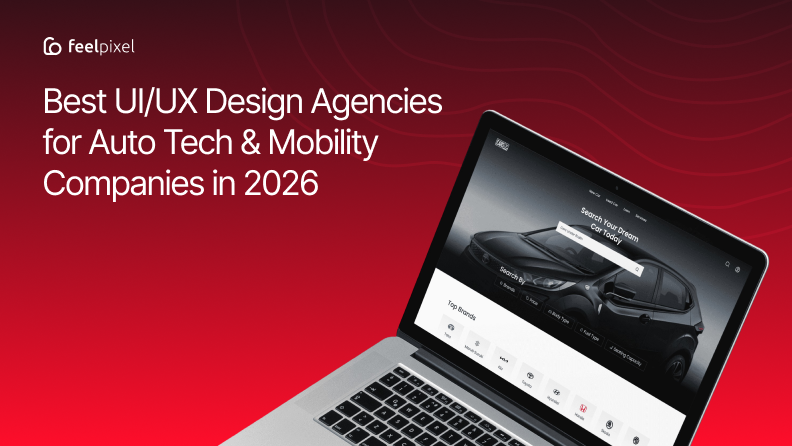
Best UI/UX Design Agencies for Auto Tech & Mobility Companies in 2026
Looking for the best UI/UX design agencies for automotive and mobility companies?
Here are the top firms specialising in designing safer, smarter, and more intuitive
in-vehicle and connected mobility experiences.
With rapid software adoption in vehicles, increasing consumer expectations shaped by
smartphones, and the rise of EVs and fleet platforms, digital experience has become
the backbone of modern mobility. From infotainment systems to companion apps and
fleet dashboards, UX plays a critical role in building driver trust, improving safety, and
driving long-term brand loyalty.
Why Automotive UX Is a Different Challenge Entirely?
Over the past few years, the automotive industry has undergone a massive digital
transformation. Over-the-air updates, companion apps, and AI-powered in-vehicle
assistants increasingly replace physical dials, printed manuals, and dealership-only
service interactions.
As vehicles evolve into software-defined products, user experience has emerged as the
key differentiator. Today, it’s not just about horsepower or range; it’s about how
intuitively, safely, and clearly drivers can interact with their vehicle’s digital systems.
In 2026, automotive companies need more than functional interfaces. They need an
intuitive, driver-aware, and scalable UI/UX design that simplifies complex in-vehicle
workflows and improves real-world usability.
Here's what makes automotive UX uniquely hard:
- The environment is hostile sunlight, vibration, gloved hands, and split-second attention
- The user is never fully present; every interaction competes with the primary task of driving
- Hardware refresh cycles of 5–7 years clash with software expectations shaped by smartphones
- Regulatory requirements vary across global markets and must be designed from day one
Industry Statistics Worth Knowing
- Modern vehicles can contain over 100 million lines of software code, making
digital user experience a critical component of automotive design.
Source: McKinsey & Co. - Research has shown that some in-vehicle infotainment tasks can require drivers
to take their eyes and attention off the road for more than 20 seconds, increasing
safety risks.
Source: https://aaafoundation.org/research/ - Consumers increasingly value digital features such as connectivity, intelligent
infotainment, and seamless app integration when purchasing electric vehicles.
Source: Deloitte Global Automotive Consumer Study 2025 - Connected vehicle services and companion mobile apps play a significant role in
customer satisfaction, retention, and long-term brand loyalty.
Source: https://www.jdpower.com/business - According to industry research, software-defined vehicles are transforming the
automotive sector, making intuitive user interfaces and over-the-air digital
experiences key competitive differentiators.
Source: https://www.ibm.com/think/topics/software-defined-vehicle
What the Best Automotive UX Agencies Actually Do
Most people assume automotive UX agencies design screens. The best ones design
entire ecosystems.
There are three distinct surfaces in a connected vehicle experience, and most
companies only invest in one of them well:
1. In-Vehicle Experience
This includes infotainment systems, digital instrument clusters, head-up displays
(HUDs), voice interfaces, and ambient controls. It is the most visible part of the user
experience and the one most closely tied to driver safety.
Designing for the vehicle environment requires balancing usability, attention
management, hardware limitations, and regulatory requirements. Every interaction must
help drivers accomplish tasks quickly while minimizing distraction.
2. Companion App Experience
Companion apps allow users to interact with their vehicles beyond the driving
experience. Common features include remote locking and unlocking, vehicle status
monitoring, charge management for electric vehicles, service scheduling, and trip
tracking.
For many customers, the companion app becomes their most frequent point of
interaction with the brand. A poor mobile experience can negatively impact customer
perception, even when the in-vehicle experience is strong.
3. Fleet and Operations Platforms
Fleet managers, dispatchers, maintenance teams, and logistics operators rely on
specialized platforms to manage vehicles and operations. These systems often handle
route planning, vehicle health monitoring, maintenance workflows, and operational
reporting.
While less visible to end users, these platforms have a significant impact on operational
efficiency and business performance. Poorly designed workflows can create friction,
increase costs, and reduce productivity.
The Insight Most Agencies Miss: More Screen Is Not More UX
EVs freed up the interior- no gear tunnel, no engine noise, no legacy layout constraints.
Designers responded with bigger screens. Sometimes there are many screens.
But more screen isn’t more UX.
Tesla’s decision to move climate controls behind a touchscreen sparked backlash from
usability researchers, not just traditionalists. A physical knob can be operated without
looking. A flat glass surface cannot. In a moving vehicle, that difference isn’t aesthetic;
it’s a safety issue.
The best automotive UX agencies understand that the most advanced design decision
is sometimes choosing not to digitise something.
Real-world example: At Feelpixel, we believe great automotive UX should feel natural,
not demanding. Instead of overwhelming users with features, we focus on presenting
the right information at the right time, guiding actions through clear and intuitive
interactions. By reducing cognitive load and minimizing distractions, we create
experiences that help users stay focused, make confident decisions, and effortlessly
access the controls and information they need.
What to Look for in an Automotive UX Design Agency
Not all design agencies are equipped to work in automotive. Here’s what separates the
ones that are:
Deep Automotive Domain Knowledge
Automotive products operate within strict technical and regulatory constraints. A strong
agency should understand driver distraction principles, vehicle safety considerations,
Android Automotive, QNX, and the realities of OEM development environments. This
knowledge helps teams create experiences that are both user-friendly and technically
feasible.
Systems Thinking
Modern vehicle experiences extend far beyond the dashboard. Drivers interact with
vehicles through in-car systems, mobile applications, connected services, and
operational platforms. The best agencies design these experiences as part of a
connected ecosystem rather than treating them as isolated products.
Scalable Design Systems
As vehicles become increasingly software-defined, digital experiences must evolve
through continuous updates. A well-structured design system ensures consistency
across features, platforms, and over-the-air (OTA) updates while allowing products to
scale efficiently over time.
Cross-Market Experience
Automotive products often serve global audiences. User expectations, regulations, and
market requirements can vary significantly across regions. Agencies with international
experience are better equipped to design solutions that work across diverse markets
and customer segments.
At Feelpixel, automotive design experiences that go beyond screens and interfaces.
From in-vehicle systems and companion apps to fleet platforms, we create connected,
intuitive, and user-friendly experiences across the entire mobility ecosystem. The focus
is simple: making technology easier to use while keeping people at the center of every
design decision.
What the Automotive UX Market Is Telling Us Right Now
As vehicles become increasingly software-driven, great user experience has become a
competitive advantage rather than an optional feature. From connected cars and
mobility apps to fleet platforms and in-vehicle systems, intuitive design directly impacts
customer satisfaction, product adoption, and brand loyalty.
The leading automotive UX agencies in 2026 combine mobility expertise, user research,
and AI-powered design workflows to create seamless digital experiences across the
entire automotive ecosystem. The right partner isn’t simply the biggest agency—it’s the
one with proven automotive experience and the ability to solve your specific product
challenges.
1. Feelpixel
Best for Automotive UX, Connected Mobility Platforms & Design Systems
What sets Feelpixel apart is its deep experience designing digital products specifically
for the automotive and mobility ecosystem. Rather than focusing only on interface
design, the agency works across the entire connected vehicle journey,from customer
acquisition and vehicle discovery to fleet management, mobility services, and
operational platforms.
Founded by an IIT Bombay design graduate, Feelpixel combines automotive domain
expertise with scalable design systems, user research, and AI-assisted UX workflows to
build products that are intuitive, efficient, and ready for growth.
Key Automotive Work
- CARS24 New Car – Designed the end-to-end UX/UI for a leading new car buying platform, simplifying vehicle discovery, comparison, and purchase across web and mobile.
- Cautio – Designed an AI-powered driver safety platform focused on improving road safety through real-time monitoring and actionable insights.
- AutoPilot – Created the UX for a fleet and vehicle management platform that streamlines operations, monitoring, and decision-making.
- Orbit – Designed a connected mobility platform that enables seamless vehicle tracking, fleet management, and operational efficiency.
- Aoki – Developed intuitive user experiences for a connected automotive solution, enhancing vehicle interaction and digital mobility services.
Strengths
- Automotive UX Research
- Connected Mobility Platforms
- Vehicle Marketplace Design
- Fleet & Operations Dashboards
- Design Systems
- Usability Testing
- AI-Assisted UX Research
2. Think Design
Best for Research-Led Enterprise UX & Automotive Innovation
Think Design is one of India’s most globally recognized UX consultancies, with 125+
designers across studios in Bengaluru, Mumbai, Singapore, and the US. Part of the
Havas Group network, they have delivered human-centered design for clients, including
Mahindra. Their strength lies in enterprise-scale UX and complex systems, making them
a strong fit for OEM and mobility platform projects.
Strengths
- User Research
- Customer Journey Mapping
- Enterprise UX
- Service Design
- Design Strategy
- Human-Centered Design
3. Clay
Best for Premium Digital Experiences & Connected Mobility Product Design
Clay is a globally recognized digital product and UI/UX design agency known for
creating premium digital experiences for startups, enterprises, and technology
companies worldwide, the agency specializes in product strategy, UX design, visual
design, and branding for complex digital products. Their expertise in designing intuitive
interfaces, connected ecosystems, and scalable digital platforms makes them a strong
fit for automotive and mobility companies building next-generation connected vehicle
experiences, companion applications, and mobility platforms.
Strengths
- Product Strategy
- UX Design
- Connected Vehicle Experiences
- Digital Product Design
- Design Systems
- Branding & Visual Design
4. ProCreator Design
Best for Scalable Product UX & Mobility Platform Design
ProCreator Design is a leading UI/UX design agency headquartered in Mumbai,
specializing in product design, user experience strategy, and digital transformation. The
agency works with businesses across industries to create intuitive, scalable, and
user-centric digital products. Within the mobility and transportation sector, ProCreator
has experience designing customer-facing applications, operational platforms, and
enterprise solutions that improve usability and streamline workflows.
Strengths
- UX Strategy
- Enterprise Product Design
- Mobility Platforms
- Customer Experience Design
- Operational Dashboards
- Digital Transformation
5.Yellow Slice
Best for Mobility Apps & Customer Experience Design
Yellow Slice has established itself as India’s strategic UX/UI design consultation
company with 16+ years of experience. Their key automotive and mobility clients
include Mahindra, Tata Health, and Bajaj Finserv. Their process-driven, research-first
approach suits automotive brands that need deep user journey mapping before
committing to interface design.
Strengths
- Mobile UX
- Automotive & Mobility Applications
- UX Research
- Product Design
- Customer Journey Mapping
- Usability Testing
Ready to Create Better Automotive Experiences?
Whether you’re building a connected vehicle platform, EV ecosystem, companion app,
fleet management solution or next-generation infotainment experience, great UX can
have a lasting impact on usability, customer satisfaction and brand loyalty.
At Feelpixel, we help automotive and mobility companies transform complex vehicle
interactions into intuitive, user-centered experiences. From UX research and design
systems to in-vehicle interfaces and companion apps, we create digital products that
are safer, easier to use, and built to scale.
If you’re planning a new mobility product, redesigning an existing experience, or looking
for an expert UX audit, let’s discuss how thoughtful design can help drive better
outcomes for your users and your business.
Frequently Asked Questions
What makes automotive UX different, and how does Feelpixel approach it?
Automotive interfaces face challenges that few other digital products encounter,
including divided driver attention, harsh lighting conditions, physical ergonomics, and strict safety regulations. Feelpixel’s design process addresses cognitive load,
eyes-on-road time, and regulatory requirements from the earliest stages of wireframing
rather than treating them as afterthoughts.
Can Feelpixel design both the in-vehicle interface and the companion app?
Yes. Feelpixel designs experiences across all connected touchpoints, including the
in-vehicle interface, mobile companion applications, and fleet or dealer management
dashboards. Maintaining consistency across these platforms is essential, which is why
developing scalable design systems is a core part of Feelpixel’s approach.
What should an automotive brand look for when hiring a UX agency?
An automotive UX agency should have experience working within industry constraints,
including safety requirements, OEM platforms, and connected vehicle ecosystems.
Brands should look for agencies with proven expertise in building scalable design
systems, designing for over-the-air updates, and creating experiences that prioritize
both usability and safety.
What does a UI/UX design agency for automotive actually do?
Automotive UX agencies design the digital experiences that drivers and operators
interact with, including infotainment systems, companion mobile applications, fleet
management dashboards, and the connections between these platforms. Leading
agencies also create design systems that ensure consistency across updates, products,
and international markets.
How is automotive UX design different from regular UX design?
Automotive UX operates under unique constraints. Interfaces must remain usable while
the user is moving, often in bright sunlight and with limited attention available. Every
design decision must carefully balance cognitive load, physical ergonomics,
accessibility, and regulatory compliance.
Why is the companion app so important?
For many users, the companion app becomes the primary touchpoint with the vehicle.
Drivers use it daily to check battery status, unlock the vehicle remotely, schedule
servicing, and manage vehicle settings. A poor app experience can negatively impact
the perception of the entire automotive brand, regardless of the quality of the vehicle
itself.
Is accessibility important in automotive UX?
Absolutely. Accessibility is becoming increasingly important and is often supported by
regulatory requirements. Designing for older drivers, users with temporary impairments,
and people with varying levels of technical familiarity creates better experiences for
everyone while expanding the potential user base.