The Feelpixel Enterprise UX & Design System Approach to Scalable SaaS Products

Illustration of a website redesign strategy covering UX research, IA, conversion optimization, and scalable CMS design

Why Enterprise SaaS Products Become Harder to Scale?

Most enterprise SaaS products don’t become difficult to use overnight. The change happens gradually. A new feature introduces another interaction pattern. A new team creates a different version of an existing component.Hence, Enterprise SaaS Design System Approach is really important to be defined at the beginning

A dashboard evolves independently from the rest of the platform. Over time, what started as a unified product becomes a collection of disconnected experiences.
The challenge isn’t just visual inconsistency. Development slows down. Product teams spend time solving the same problems repeatedly. New features take longer to launch. Users need to relearn interactions that should feel familiar.
At Feelpixel, our design system process starts long before components, tokens, or documentation are created. We begin by understanding workflows, user roles, business objectives, information architecture, and the operational realities of the product. This helps us create systems that support both immediate product needs and long-term scalability.
Not as a collection of buttons and components, but as a foundation that helps products scale without accumulating complexity.

Why This Becomes a Business Problem, Not Just a Design One

Enterprise software is rarely static. New workflows get introduced, teams expand, user roles get more complex, product offerings mature, and entire modules get added over time. What worked fine for a platform with twenty screens often breaks down once that same product grows to hundreds of screens used by multiple teams across different functions.

Without a design system, that growth tends to create:
  • Inconsistent user experiences across modules
  • Growing design and development debt
  • Slower feature releases
  • Duplicate effort across teams
  • Difficult onboarding for new designers and developers
  • Increased maintenance costs
  • Lower user confidence and adoption
That last point is not just a feeling. A Gartner survey of nearly 5,000 enterprise software users found that 60% had been frustrated by new software within the previous two years, and 56% said the experience made them wish their company had simply kept the old system.
For businesses, these problems directly affect scalability. For product teams, they reduce efficiency. For users, they create friction. A well structured design system solves all three at once, by giving designers, developers, and product teams a shared language to build faster while still delivering a consistent experience.

The Challenges We Commonly See Across Enterprise Products

Most organisations don’t decide to invest in a design system because they need better buttons.

They invest because product complexity becomes difficult to manage.

Across cybersecurity, insurance, ESG, healthcare, logistics, and enterprise operations platforms, at Feelpixel, we’ve repeatedly encountered similar challenges.

What Happens When Design Systems Don't Exist?

As enterprise SaaS products grow, teams often face a similar set of challenges.

Inconsistent Product Experiences

The same interaction starts behaving differently across the platform.
  • Tables use different layouts and controls
  • Filters follow different logic in different modules
  • Forms introduce new patterns instead of familiar ones
  • Navigation and workflows become harder to predict
Over time, the product begins to feel fragmented, making it harder for users to build confidence and work efficiently.

Design Debt Begins to Accumulate

  • Many decisions made during the early stages of a product are often intended to be temporary. As teams move quickly, these solutions become embedded in the product and are rarely revisited.
  • What starts as a shortcut eventually becomes design debt that slows future growth and increases maintenance effort.
Development Becomes Slower
  • Without reusable foundations, teams spend valuable time recreating components, patterns, and interactions that already exist elsewhere in the product.
  • Instead of focusing on innovation and new functionality, designers and developers repeatedly solve the same problems.

Higher Cognitive Load for Users

  • Enterprise platforms often serve multiple user roles across complex workflows. Users should not have to relearn how the product works every time they move between modules.
  • Consistency helps users:
    • Complete tasks faster
    • Build confidence in the platform
    • Reduce errors and confusion
    • Improve overall productivity

Scaling Becomes More Expensive

  • Every new feature, workflow, or module requires additional effort when there is no shared system behind it.
  • As products expand, the cost of designing, building, testing, and maintaining new experiences grows significantly, making scalability harder than it needs to be.
  • This is precisely why mature enterprise products invest in design systems. Not simply for visual consistency, but to create a foundation that supports growth, efficiency, and long-term product evolution.

Why Our Approach to Design Systems Is Different

One of the biggest misconceptions about design systems is that they begin with components.

In our experience, they begin much earlier.
  • They begin when teams start asking bigger questions.
  • How should information be structured as the product grows?
  • How can users move between workflows without constantly relearning the interface?
  • How do we maintain consistency when multiple teams are building different parts of the same product?
A button library alone can’t answer those questions.
That’s why when we work on enterprise SaaS products, we spend as much time understanding workflows as we do designing interfaces.
We look at how people make decisions, where friction appears, how information flows through the system, and how different teams interact with the product. We study operational requirements alongside user expectations because scalability is rarely just a design challenge. More often, it’s a product challenge, a process challenge, and sometimes even an organizational challenge.
What we’ve learned is that consistency isn’t created by repeating the same component everywhere.
It’s created by establishing shared patterns, shared behaviors, and shared expectations.
  • When users know what to expect, they move faster.
  • When teams know what to build, they move faster.
When products have a clear foundation, growth becomes significantly easier to manage.

This philosophy has shaped how we’ve approached projects across cybersecurity, insurance, sustainability, healthcare, AI, and enterprise operations, helping teams create products that remain usable, scalable, and cohesive as they evolve.

Why Our Approach to Design Systems Is Different

The best way to understand the Feelpixel approach is to see how it has been applied across real enterprise SaaS products. While every product requires a different strategy, our design process consistently focuses on scalability, consistency, usability, and long-term product growth.
Lythouse: Building a Scalable Foundation for ESG Data
Through the Feelpixel design system process, our focus was to create a scalable foundation that could support future ESG product expansion while simplifying complex sustainability workflows.
What We Did
  • Built a scalable design system
  • Standardized reporting and dashboard experiences
  • Established reusable components and patterns
  • Improved information hierarchy
  • Simplified complex ESG workflows
Impact
  • $10 Trillion supplier spend data processed
  • 50% faster data processing
  • Scalable framework for future sustainability requirements
“Our work with Lythouse was more than just a design project. We simplified carbon and supplier data tracking, reporting, and goal setting while creating a scalable design system for future growth and consistency.”
— Aman Tripathi, UX Designer

Key Learnings

  • Design systems become critical as data complexity grows
  • Standardized reporting improves decision-making
  • Consistency reduces future maintenance effort
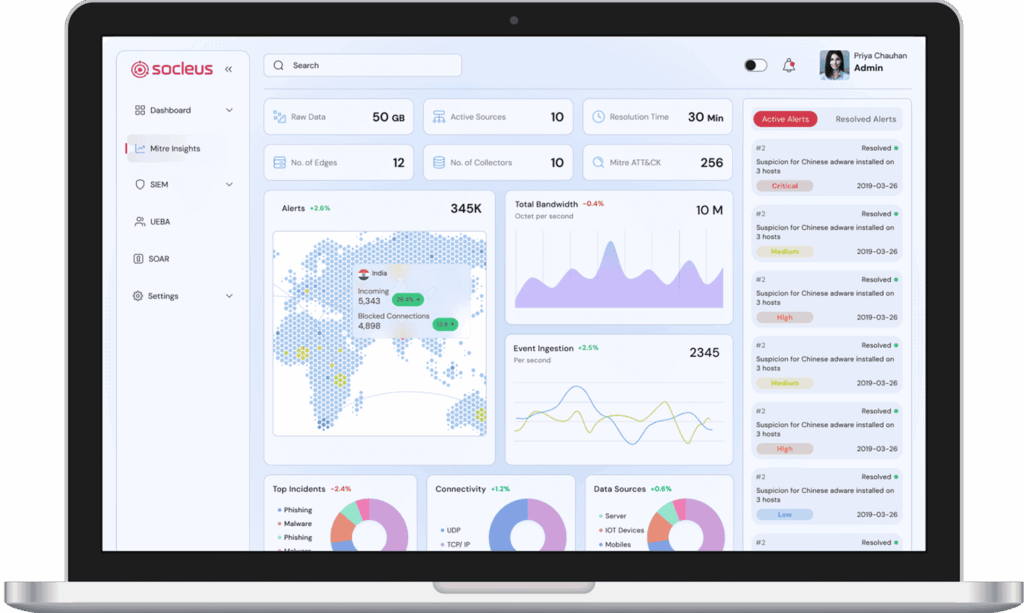
Socleus: Creating Consistency Across Cybersecurity Workflows
Cybersecurity products often contain some of the most complex workflows in enterprise software.

Security teams need to monitor threats, assess risks, investigate incidents, and take action quickly.

Following the Feelpixel enterprise UX process, we focused on reducing complexity without compromising the depth and functionality required by security teams.

What We Did Differently

  • Redesigned uniformed navigation architecture
  • Unified customised dashboard experiences
  • Standardized monitoring and investigation workflows
  • Established reusable patterns across modules for scalability
  • Introduced dark and light ode through variables
  • Improved discoverability and hierarchy

Impact

  • 20% more accurate risk insights
  • Improved risk data organization
  • Scalable and adaptive risk framework
“Working with FeelPixel has been amazing. From the very start, their team took the time to really understand what we wanted and turned that vision into a beautiful, easy-to-use design. Their attention to detail and creativity really stood out throughout the process. They provided great suggestions and worked closely with us to make sure the final product was not just visually stunning, but also intuitive and practical. If you’re looking for a UI/UX team that truly gets your needs and delivers top-notch results, I highly recommend FeelPixel!” — Mr. Viratsinh Parmar ( Engineering Manager, Cyber Evolve )

Key Learnings

  • Better structure often creates more value than additional features
  • Consistency improves operational efficiency
  • Standardized workflows reduce cognitive load

DeepScan: Building Trust in AI Powered Cybersecurity

AI-powered products need to communicate complex information with clarity.
For DeepScan, our goal was to establish a scalable design language that supported both technical workflows and business communication.

Impact

  • Zero false positives validated through real-time exploitation
  • Enterprise-ready reports generated in 72 hours instead of weeks
  • 10x operational efficiency
“Feelpixel’s understanding of AI and cybersecurity helped us align quickly from the start. They translated complex security workflows into impactful, usable experiences.”
— Surya Mettupalli, Founder & CEO, DeepScan

Key Learnings

  • Trust is a fundamental design system principle
  • Consistency improves product adoption
  • Clear patterns improve confidence in AI products

GIST Impact: Making Sustainability Data Easier to Understand

GIST Impact helps investors and organizations analyze sustainability performance at scale.

The challenge wasn’t access to data.
The challenge was making vast amounts of information understandable and actionable.

Impact

  • $8 Trillion assets managed using GIST Impact insights
  • 14,500+ companies analyzed
  • Improved sustainability reporting clarity
“Feelpixel’s knowledge of KPI visualization and impact reporting made the product experience more intuitive and impactful.” — Anupam Ravi, SVP Investor Services, GIST Impact

Key Learnings

  • Data-heavy products benefit significantly from design systems
  • Standardized visualizations improve usability
  • Consistency improves analytical confidence

Other Enterprise SaaS Products We've Designed

Beyond these engagements, we’ve worked with organizations across insurance, healthcare, operations, surveillance technology, AI, and enterprise management.
Each project reinforced the same lesson. As products scale, consistency becomes a competitive advantage.
Explore more SaaS and enterprise product design work: https://www.feelpixel.in/projects/?category=b2b-saas

What This Adds Up To

  • Design systems are business assets, not just design deliverables
  • Consistency improves usability and scalability together
  • Reducing design debt improves long term product velocity
  • Standardised patterns accelerate development
  • Better systems create better user experiences
  • Enterprise growth becomes easier when foundations are established early
  • Design systems help organisations scale products, teams, and operations together
  • The Feelpixel design process focuses on creating scalable foundations before creating scalable interfaces.
  • Strong design systems begin with product strategy, workflows, and user understanding.

The Tools We Use (And Why They Aren't the Most Important Part)

Clients often ask us which tools we use to build and maintain design systems.
The answer is simple: we use the tools that best support collaboration, scalability, and long-term product growth.
Some of the tools commonly used in our workflow include:
Figma
For creating component libraries, design systems, variables, reusable patterns, and product experiences that can scale across teams and products.
Storybook
For bridging the gap between design and development by creating a shared source of truth for components and interactions.
Design Tokens & Variables For managing colors, typography, spacing, and system-wide changes efficiently across growing products.
Jira, Miro, and FigJam
For product planning, stakeholder collaboration, workflow mapping, and aligning design decisions with business goals. That said, tools are only a small part of the equation.
Five years ago, teams were using different tools. Five years from now, new tools will emerge. Technology evolves quickly, and design workflows evolve with it. What doesn’t change is the ability to think systematically.
“A successful design system isn’t built because a team uses Figma or Storybook.”
It’s built because designers, developers, and product teams understand how a product will grow, where complexity will emerge, and how consistency can be maintained as the business scales.
At Feelpixel, we view tools as enablers, not solutions.
“The real value comes from creating a foundation that can support future products, future teams, future features, and future business goals. The software may change, but the principles behind scalable product design remain the same.”
— Feelpixel Team

Frequently Asked Questions

What is a design system in enterprise SaaS products?
A design system is a structured collection of reusable components, design patterns, guidelines, documentation, and interaction standards that help enterprise SaaS teams build consistent product experiences at scale. Beyond visual consistency, a design system creates a shared language between designers, developers, and product teams, making it easier to launch new features, maintain quality, and support long-term product growth.

As SaaS products grow, new modules, workflows, dashboards, and user roles are introduced. Without a design system, teams often create inconsistent patterns that increase complexity and slow down product development. A well-defined design system helps organizations scale faster by reducing duplication, improving collaboration, and ensuring a consistent user experience across the platform.

The best time to invest in a design system is before product complexity becomes difficult to manage. If multiple teams are working on the same product, new features are being released regularly, or users interact with several modules and workflows, a design system can help establish consistency early and reduce future design and development debt.

Design debt often occurs when products evolve without clear standards. Teams create multiple versions of similar components, interactions become inconsistent, and maintenance effort increases over time. Design systems reduce design debt by establishing reusable patterns, documentation, governance, and component libraries that prevent teams from repeatedly solving the same problems.

Yes. Design systems significantly improve development efficiency by providing reusable components and predefined interaction patterns. Instead of building elements from scratch for every feature, teams can leverage existing foundations, resulting in faster development cycles, fewer inconsistencies, and improved collaboration between design and engineering teams.
Absolutely. Users benefit from consistency. When navigation patterns, forms, dashboards, and workflows behave predictably across a platform, users spend less time learning the interface and more time accomplishing their goals. This improves usability, reduces cognitive load, increases confidence, and often contributes to stronger product adoption and retention.

A UI kit is primarily a collection of visual components such as buttons, forms, icons, and layouts. A design system goes much further. It includes design principles, interaction patterns, accessibility standards, documentation, governance processes, and implementation guidelines that help teams create cohesive experiences across an entire product ecosystem.

Enterprise products often involve multiple designers, developers, product managers, and business stakeholders working across different modules. A design system helps align these teams by creating shared standards, reducing ambiguity, improving handoffs, and ensuring that every part of the product feels connected and consistent.

Many organizations use tools such as Figma, Storybook, design tokens, and documentation platforms to manage design systems. However, the success of a design system depends less on the tools themselves and more on the strategy, governance, and collaboration processes behind it. The best design systems are built around scalable thinking rather than specific software.
At Feelpixel, we view design systems as a product scalability strategy rather than a UI deliverable. Our approach begins with understanding workflows, user roles, information architecture, and business goals before defining reusable patterns and components. This helps us create systems that remain flexible, usable, and consistent as products evolve across teams, modules, and business functions.

A Note From a Product Designer

Over the last few years, I’ve worked on enterprise SaaS products across cybersecurity, insurance, ESG, logistics, healthcare, and operational management.
One lesson keeps repeating itself.
Teams often think scalability is a technical challenge. In reality, it’s equally a design challenge.
The most successful products aren’t necessarily the ones with the most features. They’re the ones that remain clear, consistent, and easy to use as complexity grows.
I’ve seen teams spend months building new functionality only to discover users were struggling with inconsistencies that existed across existing workflows.

That’s why I believe design systems are not about creating perfect UI libraries. They’re about creating shared understanding between designers, developers, product teams, and users.

When that happens, products scale more confidently, teams move faster, and users spend less time figuring things out and more time getting work done.
— Pooja Kulkarni
Product Designer, Feelpixel

Work with Feelpixel

Scalability Starts With Strong Foundations
From cybersecurity and insurance to AI and enterprise operations, at Feelpixel, we help teams create design systems that scale with clarity, consistency, and confidence.
Let’s build design systems that help SaaS products scale faster, stay consistent, and grow with confidence.
share

Related blogs

Got a project in mind?