Quick answer
AI for preventive safety uses behavioural, environmental and operational data to identify potential risks before they become serious incidents. It combines AI based detection, behavioural analysis, contextual alerts and human centred UX to help people understand what is happening and decide what to do next. When designed effectively, preventive AI can support earlier intervention, clearer decision making and safer experiences across automotive, healthcare, industrial and other high risk environments.
Safety has traditionally been reactive. Something happens, someone responds, and only then do we look for patterns that might have helped us see it coming. AI is changing that relationship with risk.
A camera can identify signs of distraction or fatigue while a vehicle is still moving. A radar based care system can recognise a fall without requiring an older person to wear a device. Behavioral analytics can identify unusual patterns in the way people interact with a digital product.
Technology is getting better at noticing things that humans may miss. The more interesting question is what happens after something is detected. An alert is not an intervention. A prediction is not a decision. And a dashboard full of signals is not necessarily a safer experience.
This is where UX becomes important. When AI is used in safety critical environments, the interface has to help people understand what is happening, judge its importance, and respond without unnecessary confusion or anxiety. That principle applies across industries.
Why is preventive safety becoming a bigger focus?
Prevention starts with moving the point of awareness earlier. Road safety is one of the clearest examples. The World Health Organization estimates that around 1.19 million people die every year because of road traffic crashes, with another 20 to 50 million people suffering non-fatal injuries. Road traffic injuries remain the leading cause of death among people aged 5 to 29.
There is no single technology that can solve a problem of this scale. But technology can help identify certain risks earlier.
- Fatigue
- Distraction.
- Unsafe driving patterns.
- Changes in behaviour.
- Repeated incidents.
The goal is not to claim that AI can predict every accident. It cannot. The opportunity is more practical: identify signals associated with risk and bring them to someone’s attention while there is still an opportunity to respond. The same thinking applies outside mobility.
An older person falling at home may need assistance before a caregiver would otherwise know there is a problem. A healthcare system may identify a change in activity or sleep that deserves attention. An industrial system may notice a recurring pattern before it becomes a serious safety incident. Preventive safety is therefore bigger than accident prevention. It is about recognising risk early enough for human action to matter.
What does behaviour analysis mean in preventive safety?
Behaviour analysis looks at observable actions and patterns rather than treating every event as an isolated incident. In a digital product, behavioural analysis might show where people drop off, which features they use, or where they repeatedly struggle.
- A single event tells you what happened.
- A pattern can tell you that something may need attention.
This distinction becomes especially important as AI systems process more data than a person could realistically review manually.
The question is no longer simply, “Can the system detect the event?” It becomes: “Can the person using the system understand which events matter?”
How can AI help identify risk before an accident?
AI is particularly useful when there are large volumes of signals to analyse. Consider a fleet manager responsible for hundreds of vehicles. Monitoring every journey manually is neither practical nor reliable.
The benefit is not simply automation. It is attention. Instead of asking a person to watch everything, the system can help direct their attention towards something that may deserve investigation.
The same logic appears in healthcare.
KuboCare is an AI powered, radar based platform designed for caregivers and family members. It uses fall detection, real time alerts, live tracking and health and environmental monitoring to support the safety and independence of older adults.
In both examples, technology is working in the background. The user does not need to understand every part of the underlying system. They need to understand what matters now.
That is a UX problem.
Why does UX matter when AI is already analysing the behaviour?
Because detection and understanding are two different things. An AI system may detect driver fatigue.
The person receiving the alert still needs to know:
- What happened?
- How serious is it?
- When did it happen?
- Where did it happen?
- Is this a repeated pattern?
- What should I do next?
If every alert receives the same treatment, important events can disappear among routine notifications. If the interface shows too much information at once, the user has to perform the analysis that the system was supposed to make easier. Good UX creates a bridge between the intelligence of the system and the judgement of the person using it.
That means thinking carefully about:
- Priority: Which information needs attention first?
- Context: What does the user need to know before acting?
- Clarity:Can the signal be understood quickly?
- Trust: Does the interface communicate what the system knows without overstating certainty?
- Action: Is the next step obvious?
- History: Can users recognise whether something is isolated or recurring?
This becomes even more important when a wrong interpretation can have real consequences.
What happens when there are too many safety alerts?
More alerts do not necessarily mean more safety. Imagine a fleet manager receiving hundreds of notifications every day. If every event appears urgent, the interface eventually teaches the user that nothing is truly urgent.
Feelpixel’s work involved balancing Cautio’s hardware and software story while creating a digital experience that could communicate driver monitoring, fatigue detection, AI alerts and fleet capabilities clearly to different audiences. The case study also highlights the importance of trust, transparent communication and simplifying complex information through microcopy and iconography.
The design challenge was not to show everything. It was to help users find what mattered. That is a small distinction in wording, but a significant one in safety focused product design.
How does behavioural analysis support healthcare safety?
The platform brings together information about sleep, activity, vitals and the surrounding environment. The challenge was to make this information useful to families and caregivers without turning it into an overwhelming dashboard.
Feelpixel designed the alert experience around clarity, prioritisation and actionable options. Important information such as the type of fall, location and time is surfaced immediately, while the response flow provides more context instead of leaving the user with a single alarming notification.
The difference is subtle but important. The system is not simply saying: Something happened. It is helping the user understand: Something happened. Here is what we know. Here is the context. Here is what you can do.
That is preventive safety expressed through UX.
What can automotive and healthcare teach us about AI product design?
Don Norman’s principle is particularly relevant here:
“You are not your user”- A core principle popularised by Nielsen Norman Group
A fleet manager, caregiver, patient or family member can all experience the same notification very differently.
- Their context matters.
- Their level of expertise matters.
- Their emotional state matters.
- Their next action matters.
- The interface has to account for that.
Can behavioural analysis actually change behaviour?
Not by itself. Knowing that a behaviour exists is different from changing it. This is where behavioural science gives UX designers another useful lens. The Fogg Behaviour Model describes behaviour as the convergence of motivation, ability and a prompt. When one of those elements is missing, the desired behaviour may not happen.
For preventive safety, the prompt might be an AI generated alert. But an alert is only useful if the person can understand it and has a practical way to respond.
- A fatigue alert that appears at the right time but gives no meaningful next step may have limited value.
- A fall alert that creates panic without explaining what has happened may create a different kind of problem.
This is why behavioural design and UX need to work together. The technology can recognise a pattern. Design can help turn that recognition into an understandable intervention. The goal is not to manipulate behaviour. It is to give people better information at moments when better information can help them make better decisions.
What behavioural frameworks are useful for UX teams?
Behavioral frameworks can help UX teams understand why people behave in certain ways and what might help them respond differently. For preventive safety, they are useful when the goal is to recognise risky behaviour early and design interventions that help people act before an incident occurs.
The COM B model looks at behaviour through Capability, Opportunity and Motivation. It helps teams understand what may be preventing someone from taking a particular action.
For a safety experience, this could mean asking: Can the person recognise the risk? Do they have the opportunity to respond? And are they motivated to act?
The EAST framework focuses on making a desired behaviour Easy, Attractive, Social and Timely. For UX teams, it can help shape interventions that are easier to notice and act on.
In a safety context, this could mean delivering a simple warning at the right moment, without adding unnecessary effort or distraction.
The Fogg Behaviour Model is useful when the design objective includes a specific action. It asks whether the user has sufficient motivation, ability and a timely prompt to act. For preventive safety, this can help teams ask whether an alert is actually actionable.
For preventive safety, this helps UX teams ask whether the person is motivated to respond, whether the required action is easy enough and whether the prompt appears at the right moment.
For example, if an AI system detects distracted driving, simply showing “You appear distracted” may not be enough. The experience also needs to consider what the driver can realistically do in that moment and how the warning can prompt a safe response without creating another distraction.
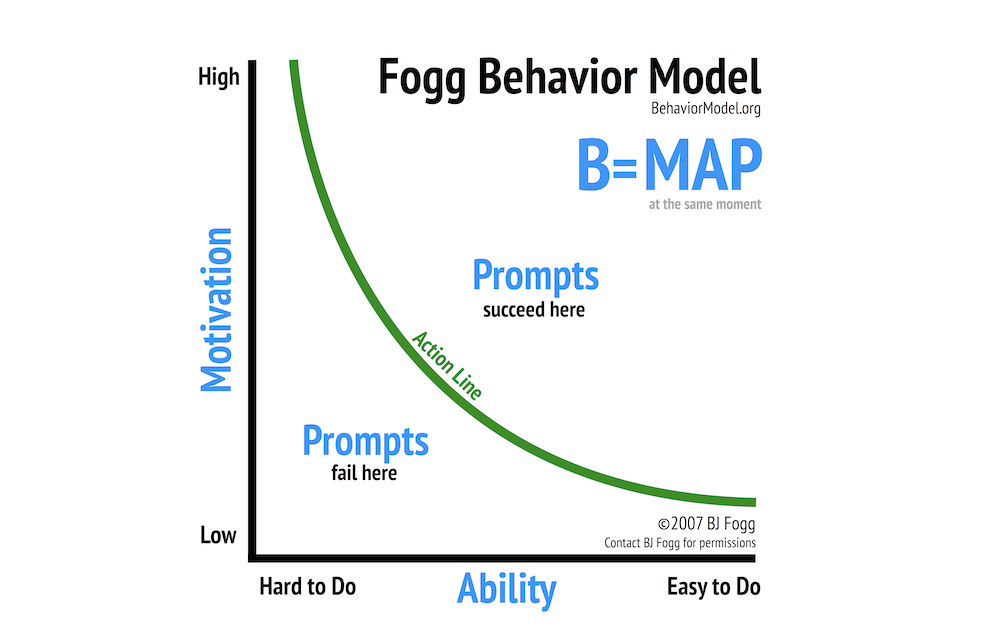
Together, these frameworks give UX teams a practical way to move from understanding behaviour to designing the intervention: understand what influences the behaviour, make the desired response easier and use the right prompt at the right moment.
What can behavioural analysis teach us about UX?
Behavioral analysis helps teams understand patterns in how people interact with a product. Event data, funnels, cohorts, heatmaps and session recordings can reveal where users hesitate, drop off, repeat an action or struggle to complete a task. But the data itself is not the insight. The important part is understanding what the pattern means and deciding what should change as a result.
What makes an AI safety alert trustworthy?
Trust does not come from adding the word “AI” to an interface.
It comes from how the system behaves and how clearly the experience communicates its limits.
A trustworthy AI safety experience should make it easier to understand:
- What the system detected
- What evidence or context is available
- How urgent the situation appears
- What the user can do
- Where human judgement is still required
This is particularly important in healthcare.
These principles are not only governance concerns. They have a direct UX implication. If an AI system affects a person’s health or safety, the experience should not hide uncertainty behind an overly confident interface. It should help people understand enough to make an informed decision.
Where else can preventive AI be useful?
The same thinking can extend beyond automotive and healthcare.
Industrial safety
AI can help identify unusual equipment behaviour, unsafe conditions or recurring patterns that deserve attention.
Behavioral analysis can help identify unusual activity and potential threats before they become larger security incidents.
Financial services
Unusual transaction patterns can be surfaced for review before fraud causes greater damage.
Insurance
Behavioral and contextual data can support better risk assessment and preventive interventions.
Workplace safety
Systems can help identify recurring patterns that may indicate unsafe working conditions. The technology will differ from one industry to another. The UX question remains remarkably consistent:
How do we turn a complex signal into something a person can understand and act on?
What should designers consider when building preventive AI products?
There is no universal interface for safety. A driver monitoring system, an elderly care platform and a cybersecurity product have very different users and consequences. But a few principles travel well across contexts.
- Design around the decision, not only the data. Start by asking what the user needs to decide rather than how much information the system can display.
- Give signals context. An isolated number or alert rarely tells the whole story.
- Prioritise before presenting. Users should not have to determine which of fifty alerts matter most.
- Design for uncertainty. AI outputs should not appear more certain than the underlying evidence allows.
- Make the next step clear. Detection has limited value if the user does not know what to do with it.
- Keep human judgement visible. In high consequence situations, AI should support decision making rather than quietly replace it.
- Test with the people who will actually use the system. The right design for a product team may not be the right design for a fleet operator, caregiver or patient.
This last point is fundamental to UX. The people building the system understand its technology. The people using it understand the problem. Those are not always the same thing.
What does preventive safety look like when designed well?
This last point is fundamental to UX. The people building the system understand its technology. The people using it understand the problem. Those are not always the same thing.
- A better prioritised alert.
- A clearer explanation.
- A useful trend instead of a stream of isolated events.
- A wellness score that makes complex health data easier to understand.
- A system that tells a fleet manager which vehicle needs attention rather than asking them to search through hundreds.
Neither experience benefited from simply adding more information. Both benefited from deciding what people needed to know, when they needed to know it, and what they could do with it. That is perhaps the most useful role UX can play in preventive AI.
What is the future of AI for preventive safety?
The next generation of safety products will likely become better at noticing small changes across large amounts of data.
But better detection will not automatically create better outcomes.
The systems that make a real difference will need to connect three things:
- Intelligence
What happens when there are too many safety alerts?
The ability to recognise meaningful signals and patterns.
- Understanding
The ability to explain those signals in a way that makes sense to the person using the product.
- Action
The ability to help that person respond appropriately.
That is why preventive safety is not only an AI problem. It is a product design problem. Whether the environment is a highway, a care facility, a factory, a workplace or a digital platform, the principle remains the same. The earlier we can recognise risk, the more opportunity we have to respond. And the better we design that moment of response, the more useful the technology becomes.
A client perspective from Cautio
The work becomes more meaningful when the people building the product can see the difference in the experience.
“Feelpixel played a critical role in shaping how Cautio presents itself to the world. They brought clarity to our vision and translated it into a cohesive brand and product experience.”
Frequently Asked Questions
What is AI for preventive safety?
AI for preventive safety uses artificial intelligence to analyse data, behaviour or environmental signals and identify potential risks early enough for people to respond. It can support applications such as driver monitoring, elderly care, industrial safety, cybersecurity and fraud detection.
How can behaviour analysis help prevent accidents?
Behaviour analysis can identify patterns associated with risk, such as driver distraction, fatigue or repeated unsafe behaviour. The value comes from identifying these signals early and presenting them clearly enough for people to take appropriate action.
How does AI detect unsafe driver behaviour?
AI based driver monitoring systems can analyse signals from cameras, sensors and vehicle data to identify behaviours such as distraction or fatigue. Cautio’s platform uses AI to analyse driver behaviour and risk signals in real time.
How is AI used for elderly care and healthcare safety?
AI can analyse signals such as movement, activity, sleep and other health or environmental information to identify events or changes that may need attention. Kubo Care uses radar based monitoring, fall detection and real time alerts to support caregivers and families.
What role does UX play in preventive safety?
UX determines how complex AI generated information is communicated to people. It helps users understand alerts, prioritise risks, access context and decide what to do next. In safety critical products, this can be as important as the underlying detection technology.
Can AI predict accidents?
AI can identify patterns and signals associated with risk, but it cannot guarantee that an accident will occur or be prevented. Preventive AI is better understood as an early warning and decision support system rather than a perfect prediction engine.
What is behavioural analytics in UX?
Behavioral analytics in UX involves analysing how people interact with a product to identify patterns in their actions, journeys and decisions. Teams can use methods such as event analysis, heatmaps, session recordings, funnels and usability research to understand what users do and where the experience needs improvement.
Which industries can use AI for preventive safety?
Automotive and healthcare are two strong examples, but preventive AI can also support industrial safety, cybersecurity, financial fraud detection, insurance and workplace safety. The appropriate application depends on the type of risk, the available data and the people responsible for responding to it.
Author's Note
AI is getting very good at noticing things. The more interesting design question is what we do with what it notices.
Working on Cautio and KuboCare made that particularly clear to me. One product looks at behaviour on the road. The other watches over older adults through radar based monitoring. The environments are completely different, but both ask the same thing from design: make complex information useful when someone needs it.
A safety alert should not simply tell someone that something happened. It should help them understand what happened, decide how much it matters and know what they can do next.
That is the part of AI product design we find most meaningful. The best experience is not necessarily the one that shows the most intelligence. It is the one that helps a person use that intelligence well.
That is the part of AI product design we find most meaningful. The best experience is not necessarily the one that shows the most intelligence. It is the one that helps a person use that intelligence well.
Work with Feelpixel
Let’s turn complex technology and behavioural data into experiences that build trust, reduce anxiety, and help people feel confident when safety matters most.