The Core Challenge
From the beginning, the redesign focused on solving three major UX problems:
- Serving multiple buyer types with completely different needs
- Making a highly complex product catalogue feel intuitive
- Articulating global credibility
Each of these problems affected how users discovered products, built trust, and ultimately contacted the brand.
Challenge 1: Designing for Multiple Buyer Types
That is rarely true in the signage industry.
- Architects searching for systems that fit a spatial environment
- Sign makers looking for technical specifications and profile codes
- Project owners evaluating long term manufacturing and implementation capabilities
Each of these users arrives with different expectations. An architect wants to see signage installed in real environments. A sign maker wants dimensional details and installation guidance. A project owner wants proof of credibility through case studies and sector experience.
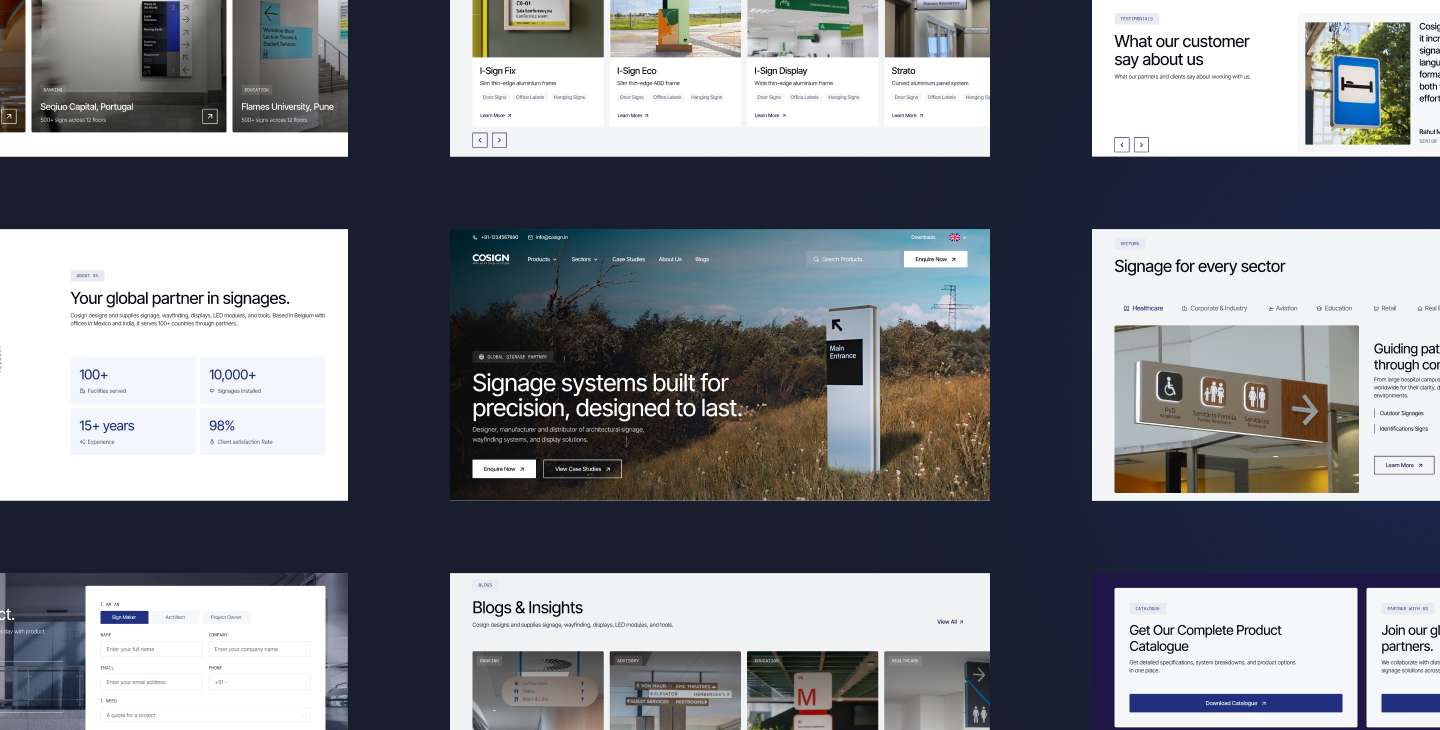
Instead of forcing every user into the same journey, Feelpixel structured the website around layered intent a core principle of user-centred design.
What We Changed
- Architect
- Sign Maker
- Project Owner
Instead of overwhelming visitors with product depth immediately, the experience gradually moves through:
- Brand credibility
- Product systems
- Industry sectors
- Case studies
- Enquiry paths
This creates a more natural decision making flow for first-time visitors.
Sector Focused Experiences
- Healthcare
- Aviation
- Retail
- Education
- Corporate spaces
- Public infrastructure
- Relevant product systems
- Real project photography
- Industry specific FAQs
- Related case studies
- Direct enquiry pathways
Challenge 2: Making a Complex Product Range Feel Navigable
Feelpixel’s redesign focused heavily on information architecture and navigation clarity.
Building a Two Layer Navigation System
- Indoor Signages
- Outdoor Signages
- LED Products
- Displays
- Exit Signs
- Eco Friendly Systems
- Modular Sign Systems
- Flexible Sign Systems
- Illuminated Systems
- Textile Frames
- Fixing and Suspension Kits
Reducing Discovery Friction
- Mega menus with visual grouping
- Hover previews with product imagery
- Scroll based browsing on category pages
- Card based layouts for fast comparison
- Structured product hierarchy for easier scanning
Users should never feel lost while browsing a large catalogue.
Product Page Structure
- Large scale installed photography
- Product overview
- Use case context
- Technical specifications
- Profile dimensions
- Accessories
- Installation videos
- Downloadable catalogues
- System configurations
Architects can focus on visual applications and environments. Technical buyers can access specifications without unnecessary friction.
Challenge 3: Balancing Global Scale with Local Relevance
Establishing Global Credibility
- 30+ years of manufacturing expertise
- Presence across 100+ countries
- Thousands of installations
- International partner networks
- Sector specific experience
Making the Local Presence Feel Real
- Belgium and Europe
- India
- Mexico
- Sweden
The Visual Direction
Product First Design Language
- Scale
- Material quality
- Environmental fit
- Design precision
A More Structured Interface
- Clean typography
- Spacious layouts
- Structured grids
- Minimal visual noise
- Controlled interaction patterns
The overall objective was for the interface to feel precise, engineered, and premium, just like the products themselves.
What the New Website Delivers
- Large infrastructure projects
- Multi building campuses
- Facility management teams
- Long term signage rollouts
What This Project Demonstrates
A hospital architect in Faridabad and an airport project manager in Brussels can now navigate the same website confidently, find what they need quickly, and understand why Cosign is a credible long term partner.