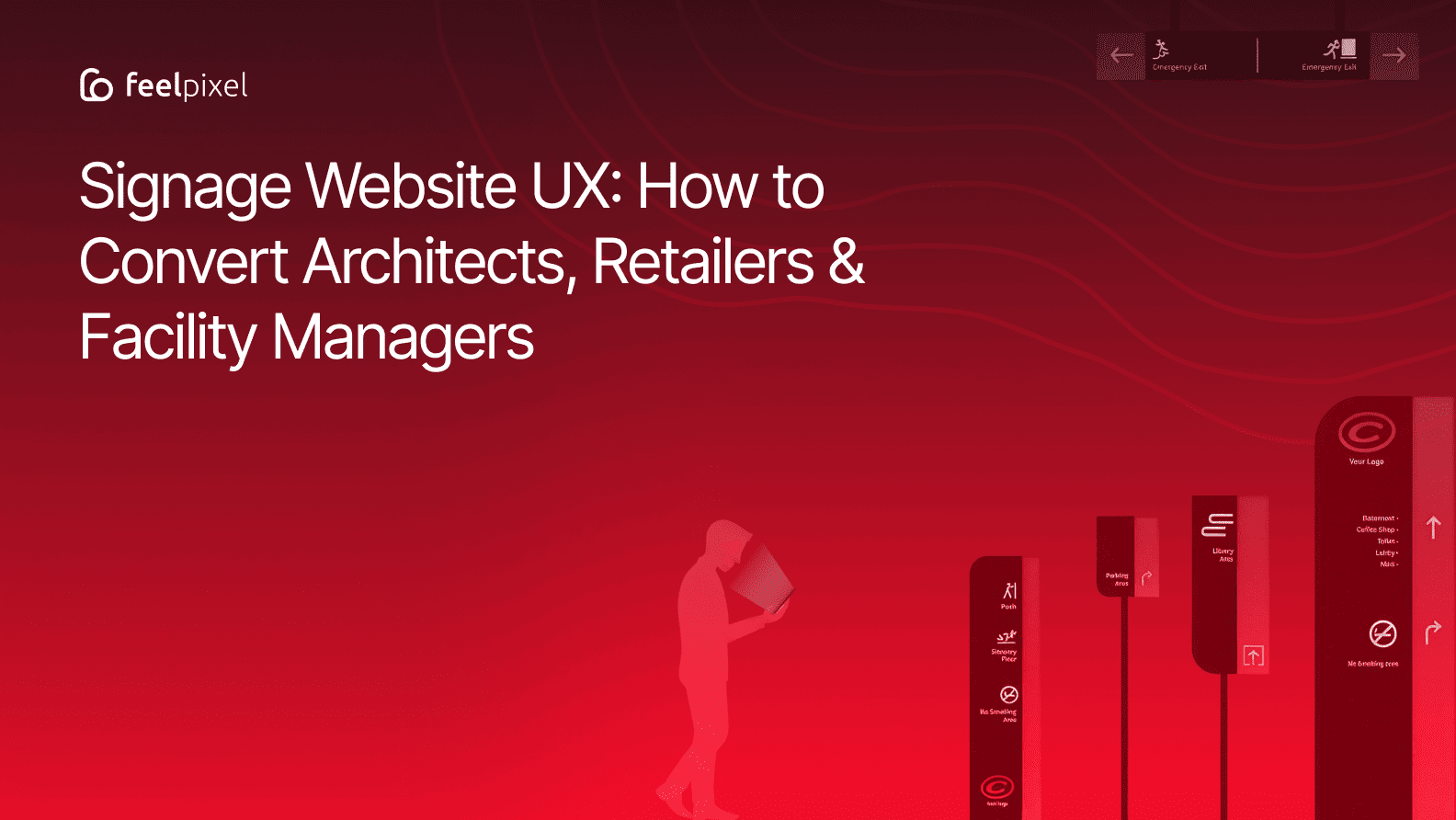
Signage Website UX: How to Convert Architects, Retailers & Facility Managers

Airport wayfinding signage system displaying directional information for terminal gates 37 to 45 and 27 to 36 with arrow indicators, installed overhead in a modern airport interior under warm ambient lighting, showing clear architectural signage designed for passenger navigation.

Learn how signage website UX design helps manufacturers convert architects, retailers, facility managers, and sign makers, with global strategies, and ROI data.

The global digital signage market is projected to reach USD 103.4 billion by 2036, growing at a CAGR of 8.2% (Source: Grand View Research, 2024). In fast-growth regions like South Asia, that pace is even sharper, India alone is forecast to reach USD 3,415 million by 2033 at 14.25% CAGR (Source: Market Research Future, 2024).
Yet most signage websites still look and behave like they were designed a decade ago.
Architects cannot find the CAD files they need. Retailers scroll through generic product galleries with no context. Facility managers give up searching for documents. Procurement teams abandon quote forms halfway through.
Poor UX doesn’t just frustrate visitors, it costs conversions.

Why UX Matters for Signage Company Websites ?

At Feelpixel, we define UX for signage company websites as the practice of structuring a signage manufacturer’s digital presence so that every visitor type whether an architect, retailer, or facility manager can quickly find what they need, understand the value, and take action without friction.
The signage industry has evolved from static boards to AI personalised digital displays, with digital signage now commanding 42% of the global market share (Source: Allied Market Research, 2024). But most manufacturer websites have not kept pace. They pack in wayfinding samples, LED specs, POS demos, and eco material details without any user centric structure.

The result: high bounce rates, low quote completions, and lost contracts to competitors with cleaner digital experiences.

The 3 Key User Types on a Signage Website (And What They Need)

Before designing or redesigning a signage website, it is essential to understand who is actually visiting and what frustrates them most. These pain points are consistent whether the buyer is in Mumbai, Manchester, or Minneapolis.
User Type Primary Need Biggest Frustration
Architects and designers Specs, CAD files, 3D renders Buried downloads, no project filters
Retailers and marketers ROI proof, POS demos Generic galleries, no sector context
Facility managers Compliance docs, maintenance data Poor hierarchy, endless scrolling

1. Architects and Designers: Ending the Spec Hunt Nightmare

The pain

Architects work to tight deadlines and need precise specifications, material datasheets, CAD files, and 3D renders fast. On most signage websites, these are buried inside cluttered galleries with no filters for environment (indoor vs outdoor), material type, or application. Slow loading visuals compound the frustration.

How Feelpixel fixes it:
We build a dedicated section of the website, separate from the general product catalogue, structured specifically around how architects research and specify materials. Information architecture is the backbone of this approach every download, filter, and spec page is placed where an architect would intuitively look for it.
Key features we implement:
  • One click CAD and BIM file downloads, organised by project type (healthcare, aviation, retail, hospitality)
  • Lightweight 3D renders with progressive loading so visuals appear quickly even on mobile
  • Technical spec previews: LED brightness ratings, IP ratings for outdoor durability, fire resistance classifications
Result: When a signage manufacturer restructured its product section around architect workflows, bounce rate dropped 47% and architect sourced enquiries increased 32% within three months.

2. Retailers and Marketers:

The pain
Retail buyers are looking for POS displays, LED video walls, and in store promotional signage but they need to justify the investment internally. Generic product dumps with no sector specific ROI data, mobile unfriendly demos, and “contact us for pricing” messages push them straight to a competitor.

How Feelpixel fixes it:
We design results focused sections that speak the language of retail KPIs. This means applying conversion centred design principles to every retail facing page.

Key features we implement:

  • Mobile first product demos with swipeable mockups showing shelf talkers and display units in actual retail environments
  • Sector specific case study carousels with concrete metrics (“A regional supermarket chain recorded 28% higher impulse purchases after installing interactive end caps”)

Impact Benchmarks

Features Before After
Product demos Static images Product in environment context, videos and interactive 3D product 40% longer sessions
Case studies Buried PDF Sector carousel with video and mockup images 3× more case study views

3. Facility Managers and Corporates:

The pain
Corporate facility managers and decision makers need wayfinding compliance documents, installation guides, warranty information, and maintenance schedules presented clearly. Most signage websites bury this information or do not have it at all, forcing managers to call or email for basic documentation that should be self serve.
How Feelpixel fixes it:

We build compliance first sections with clean information hierarchy designed so the right documents surface immediately, without requiring a call to the sales team.

Result: When facility managers can find decision ready documentation without calling your sales team, trust increases and sales cycles shorten. Clients report 40% shorter procurement timelines when compliance information is self-serve and well structured.

Industry Specific UX: Healthcare, Aviation, and Hospitality

Generic signage pages don’t convert specialist buyers. At Feelpixel, we design dedicated landing pages for each regulated or high expectation industry tailored proof points for each visitor type.

Healthcare:

Hospital project managers and procurement leads arrive knowing roughly what they need and are validating whether you can deliver it to their standard.


They are looking for modular sign systems that can be reconfigured as departments move, wayfinding totems for main entrances, overhead hanging blade signs for corridor junctions, room identification plates compatible with Braille and tactile standards, and directory boards updatable without specialist contractors. They want confirmation that surface finishes withstand repeated clinical grade cleaning and that your products have been installed in hospital environments before. A retail case study will not reassure them. They want to see a ward, a corridor, an atrium.

Aviation:
Airport operations managers and terminal development teams are among the most specification driven buyers in any industry and have little patience for websites that make them dig.
They are looking for flight information display systems, gate identification signage, baggage reclaim overhead displays, airside safety signage, and landside directional systems for car parks and ground transport. Brightness levels and ingress protection for outdoor installations matter enormously. They also want evidence of FAA, EASA, or DGCA compliance depending on their region, surfaced clearly and not buried in a downloads folder.

Retail:

Retail buyers split into two distinct visitor types: brand teams specifying in-store environments, and property managers specifying tenant guidance and common area signage.
Brand teams are looking for POS display systems, promotional totems, LED window displays, and branded fixture signage. Property managers want directory pylons, car park wayfinding, entrance blade signs, and food court overhead hanging systems. Both want to see products in context, not on a white background, and both are watching lead times closely because retail rollouts run to tight calendars.
Corporate Offices and Commercial Interiors :
Interior designers and workplace consultants visit when speccing a new office fit-out or multi-site rebrand. They care as much about how your signage looks as what it does.
They are looking for reception identification panels, digital room name plates, directional systems for large floorplates, lift lobby directories, and external building identification. This audience is highly sensitive to finish quality. If they cannot find RAL or Pantone references, material options, or customisation details quickly, they leave.
Education :
They are looking for campus wayfinding totems, building identification, internal corridor directional systems, and changeable notice systems for timetables and events. Durability matters, as does the ability to update signage in-house without ongoing supplier costs. Value for money evidence such as lifespan data will be read carefully by this visitor type.
Hospitality :
Hotel group project managers, interior design agencies, and boutique hotel owners all visit with very different expectations but a shared sensitivity to aesthetics.
They are looking for entrance identification, lift lobby directories, room number plates, restaurant and bar identification, spa directional systems, and conference suite naming panels. For larger groups, multi-property consistency across different countries is a key concern. This visitor will judge your website design as a direct proxy for product quality.

Feelpixel in Action: The Cosign Project

We recently partnered with Cosign one of the world’s most established architectural signage manufacturers, headquartered in Belgium and shipping to 100+ countries to redesign their global website. The challenge was identical to what most signage manufacturers face: a complex product catalogue, multiple buyer types, and the need to communicate global credibility while feeling locally accessible. We restructured their navigation, built sector specific pages for healthcare, aviation, retail, and education, and repositioned their compliance and technical documentation as a self-serve resource. The result is a website that works as hard as their sales team. Read the full case study

FAQs

What is UX design for a signage website?
UX design for a signage website is the process of organising content, navigation, and functionality so that different visitor types, including architects, retailers, facility managers, and procurement teams, can find specifications, pricing, and compliance information quickly and request quotes without friction.
Architects typically leave signage websites because CAD files and technical specifications are buried inside generic product galleries. Without dedicated filters for material type, environment, and application, architects cannot efficiently complete their research and move to specification.
Structured quote builders that ask project specific questions (scope, environment, timeline, budget) and return tiered options within 90 seconds reduce abandonment significantly. Unclear or “contact us for pricing” approaches are the single largest driver of procurement stage drop off.
The most effective approach is to create localised landing pages or market specific content hubs rather than translating a single global page. Each market hub should surface locally relevant certifications, currency pricing, case studies from that region, and preferred contact channels.

Conclusion

A signage manufacturer’s website is not a digital brochure. It is the first sales conversation with every architect, retailer, facility manager, and procurement officer who finds you online, regardless of where in the world they are searching from.
When that conversation is structured around their specific needs rather than your product catalogue, conversions follow.

The global signage market is growing fast and becoming more competitive. The manufacturers who invest in UX now will own the digital credibility that drives deals for the next decade.
Ready to Fix Your Signage Website?

Most signage manufacturers have excellent products buried inside a website that works against them. Architects bounce because specs are hard to find. Retailers disengage because there’s no ROI context. Procurement teams abandon because pricing is opaque.
At Feelpixel, we run focused UX redesigns that change all of this in 6 to 8 weeks. We’ve done it for signage manufacturers across healthcare, aviation, retail, and corporate sectors and the results are consistent: more enquiries, shorter sales cycles, and a website that converts.
Book a free UX audit. We will identify exactly where your current website is losing architects, retailers, and buyers, and give you a clear action plan within 5 working days.
share

Related blogs

Got a project in mind?