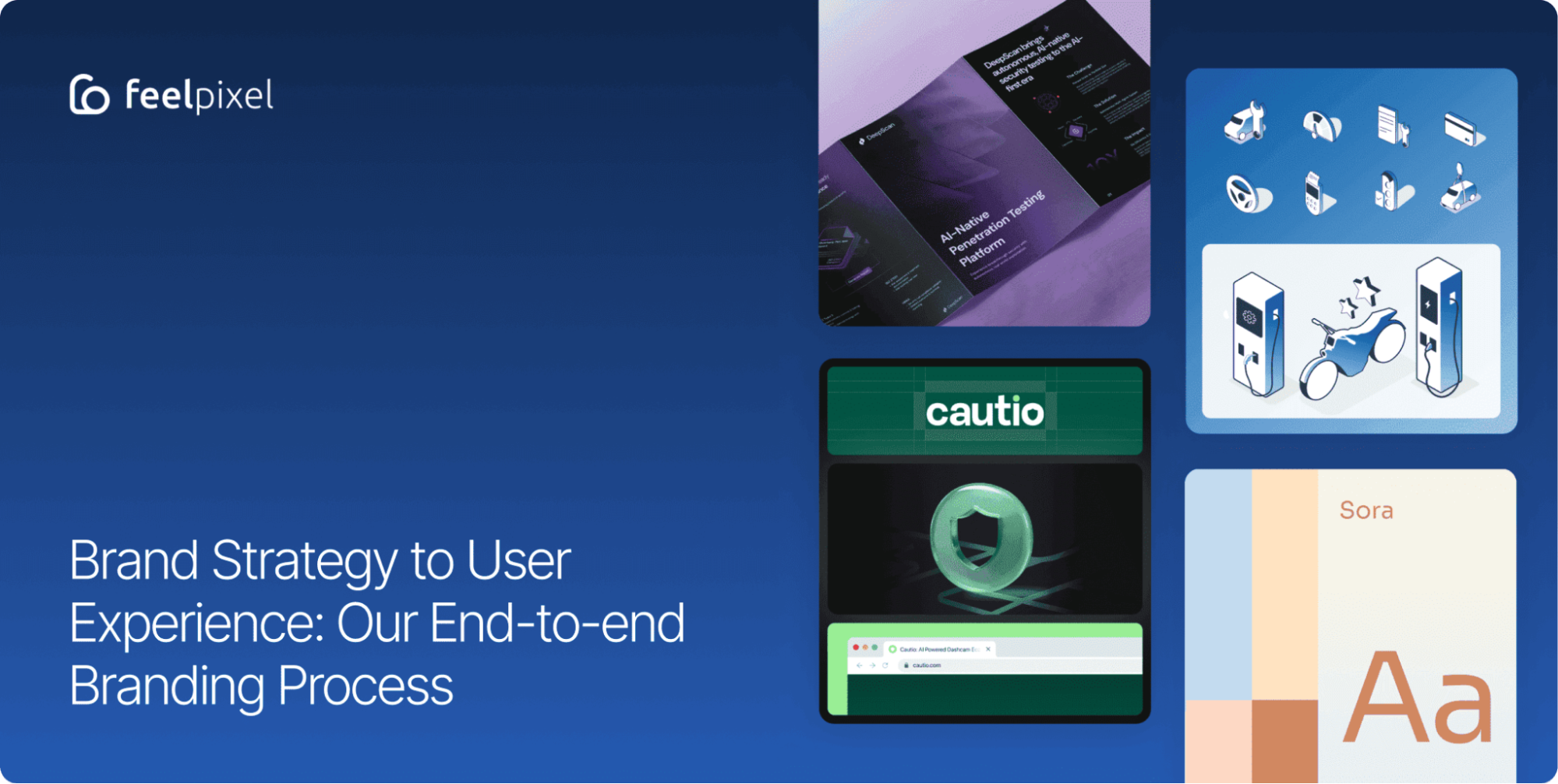
Brand Strategy to User Experience: Our End-to-end Branding Process

Brand Strategy to UX Design Process, Feelpixel branding agency

The Gap Between Brand Strategy and Product Experience Is Where Growth Gets Lost

A logo is not a brand. A brand is not a product. And a product without a clear brand behind it is just another option in a crowded market.
The brands that earn recognition, loyalty, and revenue are built from a Brand Strategy to UX Design Process that runs all the way through. From the first positioning decision to the last pixel of a product interface. Most businesses invest in parts of this. They commission a logo, build a product, run a campaign. Each piece gets attention. But when strategy, identity, and experience are not designed together, they pull in different directions and users feel it, even when they cannot name what is wrong.
McKinsey’s 2026 State of Marketing research found that branding is now the number one priority among marketing leaders, surpassing performance marketing, martech investments, and generative AI. The same research found that every brand investment has a 1.5x higher marginal return than performance marketing, even in the short term. Companies with a clear, defined brand strategy deliver 20 to 30% higher long term ROI. The business case for getting branding right has never been stronger. The execution gap has never been more visible.
At Feelpixel, we run an end to end branding process that treats strategy and user experience as a single connected discipline. This blog walks through how that process works, why each stage exists, and what it produces when done properly across the full journey from brand discovery to product experience.

Why Brand Strategy and UX Must Work Together

Most branding engagements stop at the guidelines document. Most UX engagements start from a brief that assumes the brand is already figured out. The gap between those two assumptions is where brand inconsistency lives, and that inconsistency is expensive.
Lucidpress research found that inconsistent branding costs companies up to 30% in lost revenue. Yet fewer than 10% of brands maintain high level consistency across all their products and marketing channels, according to Renderforest 2024. The inverse opportunity is equally clear: consistent brand presentation across platforms increases revenue by up to 23%, and companies with strong brand consistency are 3.5x more likely to enjoy excellent brand visibility, according to Forbes research.
The reason consistency is so rare is structural. Brand and product are typically handled by different teams, different agencies, or different briefs, with brand guidelines handed off as a PDF and then interpreted differently by every team that receives them. Visual identity decisions get made without understanding the emotional positioning. UX decisions get made without the tone of voice principles that should be shaping them. The product ships. The brand erodes.
The fix is not a better guidelines document. It is a process where strategy, identity, and experience are designed together from the start, with each stage informing the next and the same team carrying the decisions through.
Design driven companies outperform the S&P 500 by 211% over ten years, according to the Design Management Institute. McKinsey’s five-year study found that top quartile design performers achieved 32% higher revenue growth and 56% higher total returns to shareholders. These outcomes do not come from better logos. They come from organizations where design thinking is embedded from strategy through to the user experience. That is the process Feelpixel runs on every branding engagement.

The Feelpixel End-to-end Branding Process

We build brand identities that do more than look good. They communicate a point of view, establish instant recognition, and give every product and platform a soul to design from.
Our process runs across five stages. At every stage, we work across two layers simultaneously: the functional design layer, which handles the structural decisions, and the emotional design layer, which handles how the brand feels to every audience that encounters it. Neither can be done without the other.

Stage 1: Discovery and Research

Every brand engagement begins with understanding the business, the audience, the market, and the competitive landscape. Not at a surface level, but deeply enough to know what this brand needs to stand for in order to win, and what makes it genuinely different from the alternatives.
We run stakeholder workshops and brand discovery sessions, map the audience and competitor landscape, define the brand’s scope and deliverable framework across digital, print, and product applications, and establish the business goals the brand strategy needs to serve.
On the emotional layer, we map brand personality and emotional positioning alongside trust, familiarity, and differentiation goals. Cultural and contextual sensitivity mapping ensures the brand is positioned correctly for the specific audiences and markets it is reaching, including multi regional or multilingual contexts.
What this produces:
  • Brand discovery and positioning document
  • Audience and competitor analysis
  • Brand scope and deliverable framework

Stage 2: Brand Strategy and Positioning

This is where the brand gets its architecture. Positioning, messaging, tone of voice, personality, and value proposition are defined here in a form that every downstream decision can reference. A strategy that cannot be acted on is not a strategy. Everything we produce at this stage is built to be used.
We establish the brand architecture and visual identity hierarchy, tone of voice and messaging structure, application system planning, and the brand guideline structure and scope. We also build the brand story and narrative architecture, the foundation of how the brand will communicate about itself consistently across every format and channel.
On the emotional layer, we define the emotion led visual identity direction, personality driven typography and colour rationale, and the consistency and recognition system that will hold the brand together as it scales.
What this produces:
  • Brand architecture and visual identity framework
  • Tone of voice and messaging guide
  • Brand story and narrative foundation

Stage 3: Design and Delight

This is where the brand becomes visible. Logo and identity system, typography, colour system, iconography, illustration style, photography direction, digital assets, motion guidelines, and the full brand guideline document are all produced here.
The functional decisions about what the brand looks like and how it behaves are made alongside the emotional decisions about what it feels like. Colour choices are made with emotional resonance in mind, not just category convention. Typography is chosen for personality, not just readability. Every identity expression is tested against the question of whether it works across every context the brand will live in, from a small app icon to a large format outdoor placement.
We design for recognition at scale. A brand that works beautifully in a presentation and breaks down on a product screen, a social post, or a brochure is not a finished brand. It is a finished concept.
What you get:
  • Complete visual identity system
  • Brand guideline document and asset library
  • Motion and application guidelines

Stage 4: Validations

Before a brand goes into the world, we test it against the audiences it is built for. Brand perception and recognition testing, consistency and application validation across touchpoints, and audience resonance and clarity testing are all part of this stage.
This is the stage most agencies skip, and the one most responsible for brands that look strong in isolation but fail to communicate clearly to real people in real contexts. We run brand feeling and first impression testing, differentiation and recognition validation, and consistency comfort checks to confirm the brand works as intended before it is rolled out.
Feedback from this stage feeds directly into refinements before anything goes live.
What you get:
  • Brand perception testing reports
  • Refined identity iterations

Stage 5: Implementation

A brand is only as strong as its implementation. The best identity system in the world produces no return if it is applied inconsistently, interpreted differently by different teams, or handed off without the documentation needed to use it properly.

We prepare and export every brand asset, build the digital asset library, produce the brand guideline documentation, support application across product and marketing teams, and stay involved through launch and initial rollout. Cross platform consistency assurance means the brand that ships is the brand that was designed.

What you get:
  • Complete brand asset library
  • Print and digital ready deliverables
  • Brand system for ongoing use

What Our Branding Services Cover

Brand Strategy

We define what the brand stands for, who it serves, and how it should be perceived. Through research, positioning, and messaging, we create the strategic foundation everything else builds from.
  • Brand Discovery Workshops
  • Market and Competitor Research
  • Brand Messaging and Positioning
  • Brand Persona and Tone of Voice

Visual Identity Design

We create visual identities that are distinctive, memorable, and built for consistency and scalability across digital and physical touchpoints.
  • Logo Design and Variations
  • Brand Guidelines and Systems
  • Colour Palette and Typography
  • Illustrations and Iconography Styles
  • Website Design

Brand Collateral

We bring the brand to life across marketing, digital experiences, and everyday customer interactions, ensuring consistency wherever people encounter the business.
  • Social Media Design and Templates
  • Brochures and Business Cards Design
  • Marketing and Advertising Creatives
  • Custom Marketing Videos

How Branding Decisions Shape UX

There is a widespread assumption that branding and UX are sequential disciplines. Brand comes first, UX comes after, and the guidelines get handed over somewhere in between. In practice, this sequence produces brands that look coherent in a PDF and fall apart in a product.
Emotional design challenges that assumption at its root. The branding decisions made in early strategy stages, the personality mapping, the trust positioning, the tone of voice architecture, are not upstream of the UX work. They are the UX work. Every choice about how a brand communicates emotionally determines how users respond to every interface element, every system message, every onboarding flow, and every error state that carries the brand’s voice.
The connection between emotion and decision making is well documented across consumer psychology and branding research. According to a blog by Averi AI, The Psychology of Branding: How Customers Build Emotional Connections, 95% of purchasing decisions occur subconsciously, with emotional neural pathways shaping brand preferences before rational evaluation begins. The same research found that customers with strong emotional brand connections deliver 306% higher lifetime value compared to those without. This impact extends beyond loyalty to business performance, with emotional campaigns generating 50% higher ROI than purely rational approaches.
Recent findings from Loyalty Program Trends reinforce this perspective, showing that approximately 70% of brand preference decisions are influenced by emotional factors. Similarly, Branding Statistics highlights that emotional branding can increase customer loyalty by as much as 37%. Together, these findings reveal a consistent pattern: people may justify decisions logically, but the foundation of preference, trust, and loyalty is often built emotionally.
At Feelpixel, emotional design is a formal layer of our branding process from Stage 1. Not a sensibility applied at the end, but a structured decision making discipline that runs in parallel with every functional design choice. When we define brand personality in strategy, we are also defining how the product’s UI should feel. When we establish tone of voice, we are also setting the rules for microcopy, error messages, and onboarding language. When we choose typography for emotional resonance, we are making decisions that will carry through to every screen the user encounters.
This is why the brand’s Feelpixel builds tend to feel coherent in ways that go beyond visual consistency. In the KuboCare brand, the warm technology positioning established in brand strategy became the governing principle for every healthcare dashboard design decision, from the language used in alert notifications to the colour temperature of data visualizations. In the Cautio brand, the precision and intelligence positioning established in strategy shaped the interactive product storytelling approach, the dashboard visual hierarchy, and the tone of every AI alert description. In the Loans24 brand for CARS24, the trust architecture built into the brand strategy determined how financial product features were introduced and sequenced in the product interface.
Branding does not hand off to UX. Branding is the foundation UX builds from. When that foundation is solid, coherent, and emotionally precise, every product decision that follows becomes faster, clearer, and more likely to resonate with the people it is designed for.

Brands We Have Built

Feelpixel has delivered end to end branding across technology, healthcare, finance, automotive, and education over 14 years. Here is a selection of the work:

CARS24: Scalable Brand Architecture for India's Largest Autotech Platform

Industry: Automotive
CARS24 is one of India’s leading autotech companies, offering a comprehensive range of services from buying and selling cars to facilitating loans and insurance. With an established parent brand and an expanding ecosystem of sub brands, the challenge was ensuring that each new vertical carried the CARS24 DNA while establishing its own distinct identity in the market.

The work required building a brand system that could scale rather than a single identity. We defined CARS24’s brand archetype, personality traits, and tone of voice as the foundation, then created a structured visual architecture that connected sub brands to the parent while giving each one a clear market position. Distinctive imagery styles, a consistent illustration system, and clear brand guidelines meant that teams across verticals could execute at speed without losing coherence. The brand language developed here became the design foundation that Loans24, Insure24, and Autopilot each built their individual identities from, meaning every product launch started from the same strategic root. This directly shaped the UX of each sub brand: the colour coding system we developed for Insure24 allowed users to navigate between motor, health, and daily needs insurance intuitively; the loan product personality we established for Loans24 reduced the anxiety typically associated with financial applications.

What we did:
  • Tone of voice
  • Brand guideline
  • Brand monitoring
  • Logo design for 8+ sub brands
  • Illustration system
  • Stationery
  • Signages
  • Brochures.
Impact
  • 3x production efficiency across design and marketing teams following the structured brand system
  • 8+ sub brands launched within 2 months while maintaining brand consistency and market impact
  • Faster campaign execution enabled by a predefined tone of voice and visual system across all verticals
Client Quote “Over the last 8 to 9 months, Feelpixel has helped us deeply understand our users, scale our design language system, and improve customer experience and conversions. What sets them apart is their ability to align client needs with user needs, ensuring expectations are balanced and met. Their speed of execution matches startup expectations, and the validation of their success is that we are continuing to engage with them on many more projects.”
Gajendra Jangid, Co-Founder, CARS24
View case study →

DeepScan: Brand Identity for an AI Native Cybersecurity Platform

Industry: Cybersecurity
DeepScan is an AI powered penetration testing platform that enables security teams and developers to run automated security assessments through natural language interaction, repositioning pentesting from a specialist only engagement into a conversational, AI native workflow.
The brand needed to establish enterprise credibility in a category with no existing visual benchmarks for conversational AI security. We built the visual identity around a dark, high trust foundation with luminous accents, communicating intelligence, precision, and innovation simultaneously. The brand architecture was designed to make DeepScan feel like a category leader rather than a new entrant, with a visual language that signaled technical authority without sacrificing clarity. This brand identity carried directly into the product: the same principles of structured intelligence and transparent process that informed the brand guidelines shaped the AI dashboard design, the findings architecture, and the interaction model for the conversational pentesting interface.
What we did:
Brand and colour strategy, visual asset creation, logo design, website design, social media creatives, brochures.
Impact
  • Clearer category positioning: DeepScan repositioned from a traditional pentesting tool to an AI native, conversational security platform, creating immediate market differentiation
  • Elevated product perception: the visual system reinforced enterprise credibility while signaling innovation, making DeepScan feel premium and technically advanced from first contact
  • Increased sales velocity through a brand narrative that communicated value faster by reframing security testing as real time and conversational
Client Quote
“Working with Feelpixel was an absolute pleasure. Their strong understanding of AI and cybersecurity helped us align quickly from the start. From building DeepScan’s brand identity to designing our website and AI pentesting dashboard, their clarity and product thinking stood out. They translated complex security workflows into impactful, usable experiences with precision and creativity.”
Surya Mettupalli, Co-Founder and CEO, DeepScan

Cautio: Brand Identity for AI Powered Fleet Safety Technology

Industry: Automotive
Cautio is an AI powered dashcam and fleet safety platform built for Indian roads, combining smart in cabin cameras, real time AI safety alerts, and a cloud based fleet command centre for commercial operators.
The brand needed to communicate AI powered safety intelligence credibly to two distinct audiences: fleet operators across Indian cities managing day to day operations, and enterprise B2B partners evaluating a technology platform at scale. The visual identity, motion design, and interactive 3D product storytelling were all built to hold both audiences together. Precision and intelligence needed to feel accessible, not intimidating. The brand identity shaped the product experience directly: the same visual language that communicated confidence and clarity in the brand guidelines carried through to the fleet management dashboard design, the alert hierarchy, and the driver monitoring interface.
What we did:
Brand identity, brand video, logo design, website design, brochures, motion design, illustrations and icons.
Client Quote
“Feelpixel played a critical role in shaping how Cautio presents itself to the world. They brought clarity to our vision and translated it into a cohesive brand and product experience. Our presence today feels sharp, credible, and aligned with our ambition. The product experience is intuitive and built with strong logic, enabling fleet partners to manage and track vehicles effortlessly, while giving stakeholders clear confidence in our technology.”
Ankit Acharya, Co-Founder and CEO, Cautio
View case study →

KuboCare: Brand Identity for AI Powered Senior Living Monitoring

Industry: Healthcare
KuboCare is a radar based AI platform monitoring sleep, activity, fall events, and wellness for elderly residents in care facilities without cameras or wearables. The brand challenge was significant: a technically advanced product in a deeply human and emotionally sensitive context.
The brand was built around a warm technology positioning, balancing clinical precision with human empathy. Soft, human centric tones were combined with structured, modern typography to reflect both care and AI capability. The brand needed to reassure senior living operators of the platform’s reliability while giving families the confidence that the technology monitoring their loved ones was designed with care, not just efficiency. These brand decisions were inseparable from the UX: the wellness dashboard, the alert notification design, and the family communication flows all drew from the same emotional positioning that the brand strategy established. Calm, structured, and trustworthy was not just a brand brief. It was the UX requirement.
What we did:
Brand identity, website design, brochures, brand assets.
Impact
  • Clearer market differentiation: KuboCare was positioned as an ambient AI driven care platform distinct from wearables and camera based monitoring solutions
  • Stronger trust with operators and families through empathetic storytelling and calm, technology forward visuals that balanced innovation with warmth
  • Elevated product perception through a visual system that communicated both care and advanced AI capability simultaneously
Client Quote
“Feelpixel played a pivotal role in shaping KuboCare’s digital presence. They quickly immersed themselves in our vision and the nuances of the senior care space, translating complex needs into intuitive, purposeful design. What truly sets Feelpixel apart is their strategic clarity, depth in UX thinking, and their ability to align design seamlessly with brand philosophy.”
Ayush Agarwal, Co-Founder, KuboCare
View case study →

ASUS: Revitalizing Brand Identity for a Global Technology Leader's India Launch

Industry: Ecommerce
ASUS is a global technology leader known for innovation across computing and consumer electronics. When ASUS Promo and Buyback launched their services in India, the challenge was establishing credibility in a new market for products that were extensions of a globally trusted brand, while making them recognizable and trusted in their own right for an audience encountering them for the first time.

We approached this by building from the ASUS core visual language outward. A strategic colour framework was developed to give Promo and Buyback a distinct identity while staying clearly connected to the parent brand. We built a standardized icon system and designed distinctive character illustrations that made the platform visually engaging and immediately recognizable across the website and digital campaigns. The custom illustration set gave the brand a storytelling layer that purely typographic or product led design could not provide, communicating the feeling of value and promotion in a way that resonated with the Indian market. These visual decisions shaped the website UX directly: the characters and illustrations reduced the perceived friction of a promotions and buyback platform by giving it warmth and personality, which increased engagement and made the call to action flows feel less transactional.

What we did:
Brand and colour strategy, visual asset creation, illustration and motion, website design.
Impact
  • Stronger competitive advantage through a unified custom illustration set that differentiated ASUS Promo’s identity across digital platforms
  • Increased user engagement through visually distinctive characters and illustrations that made the website more compelling
  • Greater marketing impact through consistent brand elements that made ads and promotional materials instantly recognizable
Client Quote
“The Feelpixel team’s expertise and collaboration helped us transform our end user experience. They not only redesigned the website but also ensured that every element from navigation to registration flows and custom illustration was tailored to user needs. We truly appreciate their creativity, attention to detail, and collaborative approach.”
Shivani, Customer Experience, ASUS

Auction Bazaar: Brand Identity for a Real Estate Auction Platform

Auction Bazaar is a dedicated real estate platform where users can explore, bid on, and list legally disputed properties for auction. The brand needed to establish recognition and credibility in an unfamiliar category while communicating transparency and trust to both buyers and sellers.
Using the logo’s distinctive shape as the visual foundation, we built a complete brand development program where the shape driven approach informed the colour system, typography standards, imagery guidelines, and custom illustrations. Every brand element reinforced recognition and created a cohesive identity that made Auction Bazaar feel credible, modern, and trustworthy in a category where trust is the primary purchase barrier.
What we did:
Colour strategy, typography system, imagery guidelines, custom illustrations, website design.
Impact
  • Increased brand recognition through marketing materials and guidelines that made the value proposition clearer and more compelling
  • Professional and modern visual identity that elevated the brand’s credibility and made it more relevant in the real estate category
  • Improved digital presence through a refined brand experience that strengthened online visibility
Client Quote
“When we approached Feelpixel for Auction Bazaar, they quickly immersed themselves in understanding our pain points, competitive landscape, and vision. Their knack for seamlessly bridging business goals with impactful design solutions truly stood out. What set them apart was their timely communication, deep expertise in user experience and digital brand language.”
Ramchandra Rao, CEO, Auction Bazaar
View case study →

More Brands We Have Worked With

Autopilot by CARS24 Built the brand identity and large format signage for CARS24’s Autopilot product, creating a strong physical brand presence across customer facing spaces and extending the CARS24 visual language into a distinct product identity.
Loans24 Designed the brand identity, website, and app experience for CARS24’s lending platform, building a trusted sub brand that made car and personal loans feel accessible and transparent. The brand and product work ran together, with brand positioning directly shaping how loan products were introduced and sequenced in the user journey.
Insure24 Created the brand identity and comprehensive insurance product UX for CARS24’s insurance platform, covering motor, health, and daily needs insurance. A subtle colour coding system distinguished product categories while maintaining visual harmony across the brand.
Hindustan Platinum Delivered brand collateral, brochure design, and corporate stationery for a premium industrial brand, extending the visual identity into high quality print materials with the appropriate weight and authority the brand required.
RiskProfiler Designed the brand and product identity for an AI powered cybersecurity platform covering third party risk and attack surface management, creating a visual language that communicated technical precision and enterprise trust.
QuickShift Built the brand and digital experience for a logistics and fulfilment platform, translating supply chain complexity into a visual identity that felt clear, reliable, and built for operational scale.
Provectis Developed a modern, professional brand and website for Provectis, establishing a digital presence that communicated the company’s technical expertise with contemporary visual credibility.
MIT WPU Created brand collateral and institutional communications materials for MIT World Peace University, extending the institution’s visual identity into print and digital formats.

The Business Case for Getting Branding Right

The financial argument for serious branding investment is well documented, and it goes well beyond aesthetics.
Forrester Research found that every dollar invested in UX design yields a return of $100, an average ROI of 9,900%. ZipDo’s 2026 Branding and Design research found that 70% of brands reported investing in design increased their ROI by 15% or more within one year, and 90% of consumers form an opinion about a brand within 10 seconds of encountering it. Design drives 90% of that first impression.
The consistency argument is equally compelling. Capital One Shopping 2025 research found that 68% of companies report 10 to 20% revenue growth when they maintain brand consistency over time. Companies using visual identity systems see revenue boosts of 20 to 30%, according to Nielsen Brand Research. Companies that invest in branding see a 10% increase in customer lifetime value on average.
For customer experience, the compounding effect is significant. Forbes research found that brands with superior customer experience bring in 5.7 times more revenue than competitors that lag. 84% of businesses that prioritize customer experience report a revenue boost. Organizations that concentrate on customer satisfaction enjoy 60% higher profitability than those that do not. For companies already earning $1 billion annually, investing in customer experience can deliver an average revenue increase of $700 million within three years.

Deloitte’s 2025 Consumer Loyalty research found that up to 40% of perceived brand value comes from experience, quality, and loyalty programs, not just price. The brand experience and the product experience are not separate investments. They are the same investment, and they compound together.

Key Takeaways: What We've Learned Across Branding Projects

Across 14 years of building brands for startups, enterprises, and growth-stage companies, the distance between a brand that holds together and one that quietly erodes is almost always traceable to a small number of decisions made early in the process. These are the principles that have proven consistent across every industry we have worked in.
  • Strategy without emotional positioning is just architecture. A brand can have perfect hierarchy, clear messaging, and a well-defined visual system and still feel hollow. The emotional positioning, what the brand makes people feel before they read a single word, is what determines whether it resonates or just registers.
  • Inconsistency is the most expensive thing a brand can produce. Inconsistent branding costs companies up to 30% in lost revenue, but the damage is not only financial. Every inconsistency at a touchpoint costs a unit of trust. Those units compound invisibly until a user decides they do not feel confident in the brand and acts accordingly.
  • Brand guidelines only work if teams understand the why behind the what. Most brand guidelines document rules. The ones that produce consistent implementation explain the reasoning behind each rule. When teams understand why a colour was chosen, why the tone of voice is what it is, and what emotional outcome each decision serves, they apply the brand correctly even in contexts the guidelines did not anticipate.
  • Sub-brands are a test of how deep the brand strategy actually goes. Any agency can design a logo. Building a brand architecture that can generate coherent sub-brands at speed, as we did for CARS24 across eight verticals in two months, requires a brand foundation precise enough to be replicable. If the strategy is surface level, the sub-brands will drift.
  • The product interface is the most important brand touchpoint, and the most often neglected. A brand can be beautifully consistent across marketing and completely incoherent inside the product. The UX is where users spend the most time with the brand. It deserves the same strategic attention as the visual identity.
  • First impressions are made in seconds but are built over years. 90% of consumers form an opinion within 10 seconds of encountering a brand, and design drives 90% of that impression. But that first impression only holds if every subsequent touchpoint confirms it. The goal of an end-to-end branding process is to make every touchpoint confirm the same thing.
  • Brands that endure are designed for how people feel, not just what they need to do. Function is the baseline. Recognition, loyalty, and advocacy come from brands that understood their audience emotionally and made design decisions that met them where they were. That is the work we find most worth doing.

Frequently Asked Questions

What is an end to end branding process?
An end to end branding process runs from initial brand discovery through strategy, visual identity design, application across touchpoints, validation testing, and implementation support. It treats brand strategy and user experience as a connected discipline rather than separate engagements. The goal is a brand that is consistent, coherent, and functional across every context where a customer encounters the business.
Brand strategy defines what the brand stands for, how it communicates, and what personality it projects. User experience design shapes every interaction a user has with the product or service. When these are not aligned, the brand says one thing and the product does another. Users feel the inconsistency as a lack of coherence or trust, even when they cannot articulate what is wrong. Connecting strategy to UX means every interface decision, every microcopy choice, and every interaction pattern reflects the same brand personality the strategy established.
McKinsey’s 2026 research found that companies with a clear brand strategy deliver 20 to 30% higher long term ROI, and that every brand investment has a 1.5x higher marginal return than performance marketing even in the short term. Forrester puts the average UX design ROI at 9,900%, or $100 returned for every $1 invested. Design driven companies outperform the S&P 500 by 211% over a ten year period.
Consistent brand presentation across platforms increases revenue by up to 23%, according to Lucidpress research. 68% of companies report 10 to 20% revenue growth when they maintain brand consistency over time. Inconsistent branding costs companies up to 30% in lost revenue. Fewer than 10% of brands currently maintain high level consistency across all products and marketing channels, which means for most businesses, brand consistency is a significant untapped revenue opportunity.
Five stages: Discovery and Research, Brand Strategy and Positioning, Design and Delight, Validations, and Implementation. Each stage runs a functional layer and an emotional design layer in parallel. The functional layer handles structural decisions: architecture, hierarchy, guidelines. The emotional layer handles how the brand feels: personality, tone, resonance. Deliverables at each stage are documented and handed off in formats that support consistent implementation across teams and platforms.
We have delivered end to end branding across technology, healthcare, finance, automotive, education, and hospitality. Our portfolio includes DeepScan, Cautio, KuboCare, Loans24, Insure24, Auction Bazaar, Autopilot, Cars24, Hindustan Platinum, and MIT WPU among others. We work with startups building their brand from scratch, growth stage companies going through a rebrand, and enterprises extending their brand into new products and platforms.
The timeline varies by scope. A focused brand identity engagement covering discovery, strategy, visual identity, and guidelines typically runs six to twelve weeks. A full end to end engagement that includes UX integration, brand collateral, and implementation support runs longer depending on the number of applications. We do not compress discovery and validation to meet an artificial deadline, as the decisions made in those stages determine the quality of everything that follows.

Work With Feelpixel

Feelpixel is a strategic brand and product design agency with 14 years of experience and a 4.9 star rating on Clutch, trusted by CARS24, Amazon, Gaana, and 75+ brands globally. We have delivered end to end branding across technology, healthcare, finance, automotive, and education.
Whether you are building a brand from scratch, evolving an existing identity, or trying to close the gap between what your brand says and what your product actually does, that is exactly where we start.
Our branding services:
  • Brand Strategy and Discovery
  • Visual Identity and Logo Design
  • Brand Guidelines and Systems
  • Brand Collateral and Applications
  • UX and Product Brand Integration
share

Related blogs

Got a project in mind?