A visually impressive website can still be difficult to discover. Learn how SEO,AEO,GEO-ready website design combines UX, content and development to help people find, understand and act on your business information.
Quick answer
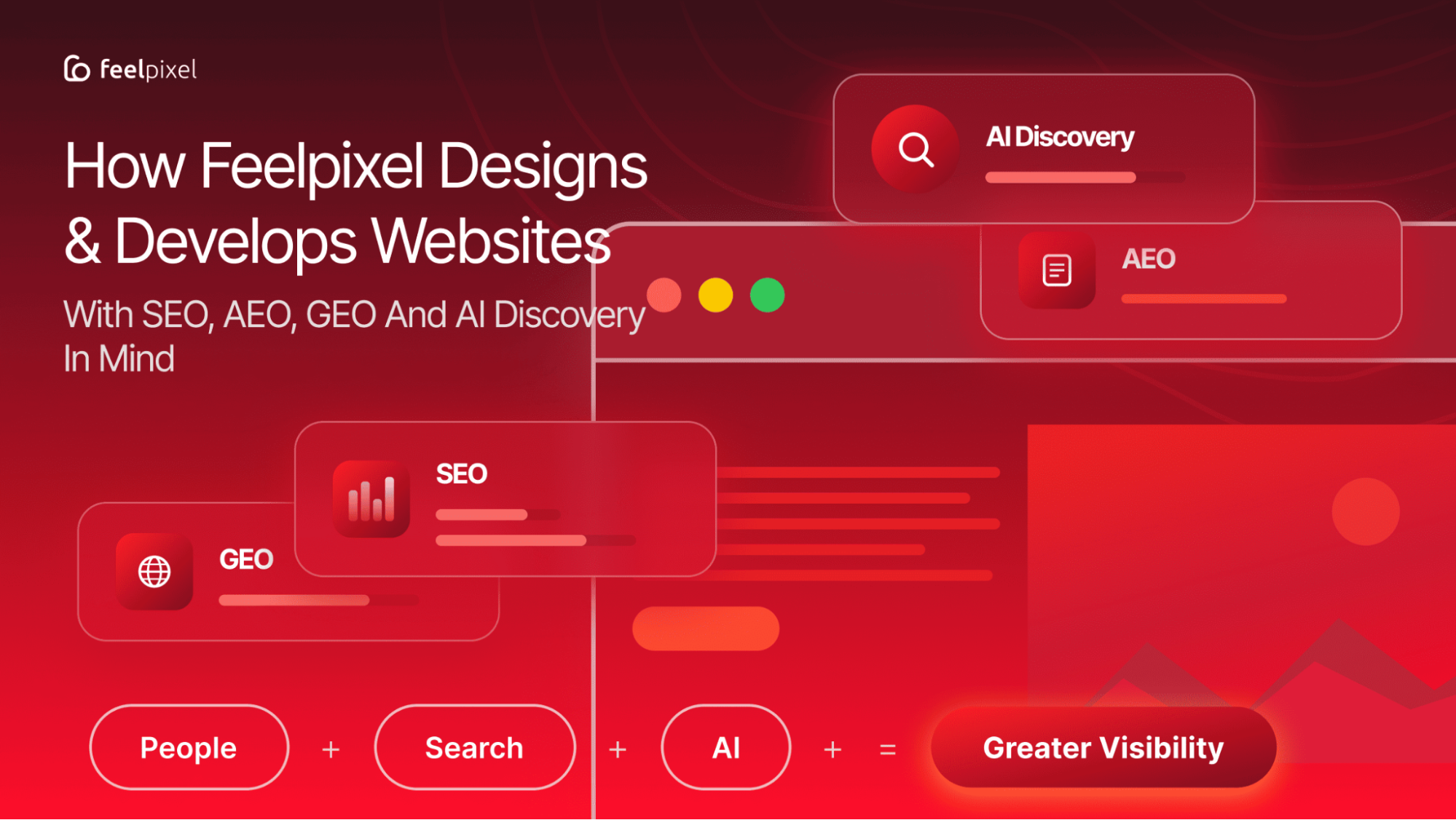
Feelpixel designs and develops websites with SEO (Search Engine Optimisation), AEO (Answer Engine Optimisation), GEO (Generative Engine Optimisation) and AI discovery built into the process from the beginning. By combining business strategy, information architecture, UX design, useful content and technical development, we create websites that are easier for people to find, understand and navigate, while helping search engines and AI systems interpret the business and its expertise. The goal is not just better visibility, but meaningful engagement and business growth.
Feelpixel Designs & Develops Websites with SEO, AEO, GEO and AI Discovery in Mind right from the start.A website can look beautiful and still be difficult to find. It can have a strong brand, thoughtful UX and technically impressive development, yet fail to answer the questions that bring the right people to it. For a long time, this was treated as an SEO problem. The website would be designed first. SEO would come later,Keywords would be added. Metadata would be written. Technical issues would be fixed. Content would be optimised after the pages were already built. But search has changed now and feelpixel takes care of that.
People still use Google to find websites, products and services. At the same time, they are increasingly asking complete questions through AI powered search experiences and expecting systems to understand businesses, compare options and surface useful information.
For businesses, a website that is difficult to discover can mean missed opportunities, fewer qualified visitors and important services going unnoticed. For users, it can mean struggling to find relevant information, understand a company’s offerings or make informed decisions.
Feelpixel is a UX and web design agency that builds SEO, AEO and GEO into website design from the first workshop, not after launch. When search visibility shapes the information architecture, content structure, page hierarchy and development from the start, websites become easier for people to use and for search engines and AI tools to understand. This article explains how we do it, with examples from our client projects.
Why Search Visibility Starts with Website Design
“SEO cannot be something we add after the website is designed”.
- Why do we bring SEO into website design from the beginning?
- What should the homepage look like?
- What does this website need to help the business achieve?
- Who needs to find it?
- What are they looking for?
- What questions do they have?
- What services matter most?
- What information helps them make a decision?
- What should they do once they arrive?
- And how should the website continue to grow as the business grows?
These questions influence the website structure before we start thinking about colours, typography or visual components. That is why our website process places Discovery and Business Goals first, followed by Information Architecture and Content Structure, before UX, UI design and development. Search is naturally part of this conversation.
Google recommends making content accessible to crawlers, using crawlable links, creating helpful people first content and ensuring important information is available in textual form. None of these are purely SEO decisions. They influence how we structure the website itself.
- If a service is important to the business, it needs a meaningful place in the information architecture.
- If a question is important to customers, the content should answer it.
- If a case study demonstrates expertise, it should be discoverable and connected to the relevant service.
- If a page is important, users and crawlers should be able to reach it.
That is where our approach begins.
1. SEO helps people find the website
For us, that can mean:
- Clear information architecture
- Search relevant page structure
- Meaningful headings
- Internal linking
- Metadata
- Crawlable navigation
- Technical performance
- Accessible content
- Structured data where appropriate
- Useful, original content
2. AEO helps the website answer questions
They might ask:
- What should I look for when choosing a website design agency? Or:
- Can a website design agency also handle SEO and AI search optimisation?
That changes how we think about content. Headings become questions. Service pages become clearer. FAQs become more useful. Content needs to provide direct answers rather than simply placing keywords throughout a page. But we do not create FAQs just because someone told us that FAQs are good for SEO. We ask whether the question is genuinely useful to the audience.
3. GEO considers generative search experiences
For us, GEO is therefore about making the website’s expertise easier to understand.
- What does the company do?
- Who does it serve?
- What problems does it solve?
- What evidence supports those claims?
- What projects demonstrate that expertise?
- How are the services, industries and case studies connected?
The clearer those relationships are, the easier the website becomes to understand. For people. For search engines. And increasingly, for AI systems.
How does information architecture affect search visibility?
One of the biggest mistakes we see is thinking about website structure only from an internal business perspective.
- A company might think about itself in terms of departments.
- Users think about problems.
- A technology company might organise itself around products.
- Potential customers may think about outcomes.
- A design agency might think about capabilities.
A prospective client might think:
- I need a new website.
- I need my website to rank.
- I need better conversion.
- I want to appear in AI search.
These are different mental models. Our job is to connect them. This is why information architecture is one of the first things we work on. A website offering website design, website development, SEO, AEO and GEO should not necessarily put everything under one generic “Services” page. Each capability may need enough space to explain what it is, who it is for, how it works and how it connects to the other capabilities.
This creates a clearer experience for users while also giving search systems a more understandable structure. Google’s documentation recommends logical site structures, crawlable URLs and links that help both users and Google understand relationships between pages. That is exactly where UX and SEO meet.
“Information architecture is not only about helping users navigate. It also helps the website communicate what it knows”.
How do we structure content for both people and search?
- We do not start with keywords.
- We start with the information the user actually needs.
- For a service page, that could mean:
- What is the service?
- Why does the business need it?
- What does the process look like?
- What capabilities are included?
- What evidence do we have?
- What questions might a prospective client ask?
- What should they do next?
This creates a much stronger content structure than starting with a keyword list and trying to build a page around it.
Google’s current guidance for generative AI search makes a similar point. It recommends unique, useful, non commodity content and specifically encourages businesses to bring first hand experience and their own point of view into their content.
- We have projects.
- We have design decisions.
- We have client problems.
- We have outcomes.
- We have experience across industries.
- That should become part of the website’s content.
How did we apply this thinking to Envision Displays?
The business already had traffic.
But traffic was not translating effectively into engagement and leads.
The website had low conversion rates, unclear product differentiation and limited trust signals. Users also found it difficult to understand which display solution was right for their needs.
So we did not approach the project as:
Redesign the website and optimise it later.
We redesigned the experience around product discoverability, search visibility and lead generation at the same time.
- The navigation was restructured around how users needed to explore products.
- Conversion touchpoints were introduced throughout the journey.
- Product information was made easier to understand.
- Trust signals were brought into important decision points.
The content structure became part of the UX.
What did Sellcraft teach us about building an SEO ready website?
Here the website needed to establish credibility while making the company’s services easier to discover.
Feelpixel redesigned Sellcraft’s brand identity and built an SEO ready WordPress website, with the goal of strengthening enterprise credibility and supporting future growth.
For us, the important part was not simply making the website “SEO friendly”. It was creating a foundation that could support the business beyond launch.
That means thinking about:
- How services are organised.
- How pages can be expanded.
- How content can be added.
- How internal links can connect related topics.
- How the CMS can support future publishing.
- How the visual system can remain consistent as new pages are introduced.
What that foundation delivered
- 30% improved content discoverability: A restructured information architecture and a clear service hierarchy make key offerings easier to find and understand.
- 40% stronger brand consistency: A unified identity system now connects the website, LinkedIn, business cards, letterheads, email signatures, presentations and other customer touch-points.
- 25% better enterprise readability: Simplified messaging and service prioritisation help enterprise decision makers quickly understand Sellcraft’s core capabilities.
- SEO ready digital foundation: The CMS powered WordPress website is built with technical SEO best practices, including metadata, schema markup, sitemap, robots.txt, and a scalable content structure to support long term organic visibility.
- 100% responsive and scalable platform: The website delivers a consistent experience across desktop, tablet and mobile devices, with easy content management through WordPress CMS.
Notice how each result maps back to the questions above. Clear service organisation drove discoverability, a consistent visual system strengthened the brand, and a scalable CMS structure means the site is ready for new content from day one.
This is why we think of SEO as a website foundation, not a post launch activity. A website should not have to be rebuilt every time the business wants to add a new service, publish a case study or expand into a new topic.
How did CloudMoyo show us why positioning comes before SEO?
Before asking:
What keywords should this page rank for?, we need to understand, What should this company be known for?
How does UX continue after someone finds the website?
- Imagine someone searching for a service.
- They find your website.
- They click.
Now what?
- Can they immediately understand what you do?
- Can they tell whether you work with companies like theirs?
- Can they find proof?
- Can they compare services?
- Can they understand the next step?
- Can they trust you enough to enquire?
Search visibility gets someone through the door. UX determines what happens next.
How do we use AEO without making websites feel robotic?
This is where content strategy becomes important. We do not want every heading to sound like it was written for a search engine.
We do not want:
- What is website design?
- Why is website design important?
- What are the benefits of website design?
repeated across every page simply because these questions have search volume. Instead, we look at the questions that naturally emerge from the user’s decision. For a website design service, that could be:
How does GEO change the way we think about case studies?
Case studies become particularly important when businesses want to establish authority in AI search.
A generic service statement says: We design high performing websites.
A case study can show:
- What was the problem?
- What did we change?
- Why did we make those decisions?
- What happened afterwards?
What does LLM readiness actually mean for a website?
- Can the relevant pages be crawled?
- Are important pages indexed?
- Can search systems access the content?
- Are internal links connecting related information?
- Is important information available as text?
- Are headings and page structures meaningful?
- Are services, industries, projects and expertise clearly explained?
“Build a website that is accessible and understandable”.
How does development support SEO, AEO and GEO?
This is where our design and development capabilities need to work together. A beautifully structured design can still lose value if the implementation makes important content inaccessible. Our development process therefore needs to consider things such as:
- Crawlable navigation
- Semantic HTML
- Responsive implementation
- Page performance
- Metadata
- Internal links
- Accessible content
- Structured data where relevant
- CMS flexibility
- XML sitemaps
- Robots.txt
- Canonical URLs
- Image optimisation
- Analytics and measurement
Structured data can also help search systems understand page content, although Google is clear that adding structured data does not guarantee a rich result.
This is why our website service combines design and development rather than treating development as simply “making the Figma file live”.
The implementation needs to preserve the strategy.
What impact does this approach create for a business?
- The impact is bigger than rankings.
- That is important to us.
- A well structured website can make the business easier to understand.
- It can improve product discovery.
- It can help visitors find the right service.
- It can make content easier to navigate.
- It can create stronger conversion paths.
- It can give sales teams better leads.
- It can create a scalable foundation for future content.
And it can make the company’s expertise easier for search systems to interpret.
“We design the website around the business problem, then build search and discoverability into the solution”.
What should a modern website be optimised for?
We do not think a website should be optimised for Google alone. Or ChatGPT alone. Or any particular search engine.
- The website should be optimised for understanding.
- People should understand it.
- Search engines should understand it.
- AI systems should be able to interpret it.
- And the business should be able to grow through it.
That means:
- Clear positioning so people understand what the business does.
- Strong information architecture so users and crawlers can find the right pages.
- Useful content that answers genuine questions.
- First hand evidence that demonstrates expertise.
- Internal linking that connects related topics.
- Technical foundations that support crawling and indexing.
- Accessible design that makes information available to more people.
- Structured data where appropriate to provide machine readable context.
- Conversion focused UX so discovery leads somewhere meaningful.
This is much more durable than trying to predict the next search algorithm.
So, is SEO becoming less important because of AI?
Google’s own guidance makes this clear. Its AI search features continue to rely on information from the web and its existing search systems, while the same foundational SEO practices remain relevant. What is changing is the way people consume information.
A user might see a traditional search result.
- They might see an AI generated overview.
- They might ask a conversational system.
- They might arrive through a recommendation.
- The discovery interface can change.
- The underlying requirement does not.
The website still needs to contain something useful enough to discover, understand and trust.
That is why our focus is not on “optimising for AI”. It is on building websites that are well structured, useful, credible and technically accessible enough to participate in the new discovery ecosystem.
The Feelpixel approach: Design for people, build for discovery
They influence how we think from the beginning.
- We start with the business.
- We understand the audience.
- We structure the information.
- We define the content.
- Then we design the experience.
- Then we build the website, test it, measure its performance and improve it.
That creates a much stronger relationship between UX and search. The result is not a website filled with keywords. It is a website where the right information is easier to find, easier to understand and easier to act on. And that is ultimately what both people and intelligent search systems need.
Search visibility starts with being understandable.
Key Strategic Takeaways
- Search visibility is a design decision, not a post-launch task. When SEO, AEO and GEO shape the information architecture, content structure and page hierarchy from the first workshop, websites become easier for people, search engines and AI systems to understand.
- Google’s guidance confirms the foundations still matter. Crawlable pages, internal links, text-based content, accessibility and useful original content remain the basis for AI Overviews and AI Mode. No separate technical requirements exist for AI search.
- Clear positioning and first-hand evidence build authority. A website needs a defined subject before it can build authority around it, and case studies that show the problem, the decisions made and the outcomes give search systems original, non-commodity content.
- Content should answer real questions, not repeat keyword templates. AEO works best as good content design: headings and FAQs drawn from genuine client questions, with direct answers a person can scan and a machine can interpret.
- Discovery only matters if it leads somewhere. Conversion-focused UX, scalable CMS structures and development that preserves the strategy ensure that visibility turns into understanding, trust and action.
Frequently Asked Questions
What is SEO in website design?
SEO in website design means considering search visibility while defining the site’s information architecture, content structure, navigation, page hierarchy and technical foundation rather than treating SEO as a post launch activity.
What is AEO?
AEO, or Answer Engine Optimisation, focuses on making useful information easier to identify and understand when users ask questions through search and answer based experiences.
What is GEO?
GEO, or Generative Engine Optimisation, is a broad term used for improving how a brand and its information can be discovered and represented in generative AI experiences. The field is still evolving, and Google currently emphasises foundational SEO and high quality content rather than a separate set of required GEO techniques.
What is LLM readiness for a website?
LLM readiness means creating a website whose important information is accessible, clearly structured and understandable to machine systems. This includes crawlability, content structure, internal linking, meaningful page relationships and accessible content.
Does SEO still matter for AI search?
Yes. Google explicitly states that existing SEO best practices remain relevant to AI Overviews and AI Mode.
Can website design affect SEO?
Yes. Information architecture, navigation, content hierarchy, internal linking, accessibility, performance and technical implementation can all affect how effectively search systems access and understand a website.
Should AEO and GEO be treated as separate website services?
They can be offered as capabilities, but we believe they work best when integrated into the website strategy. AEO influences content and information structure, while GEO brings attention to discoverability in generative search experiences. Neither should be treated as a collection of keyword tricks.
Does adding structured data guarantee better rankings?
No. Google explicitly says structured data can make pages eligible for certain search features but does not guarantee that those features will appear. It must also accurately represent the visible content on the page.
How does Feelpixel approach SEO ready website design?
We integrate SEO considerations into discovery, information architecture, content structure, UX, UI and development. The goal is to create websites that are useful for people, technically accessible to search systems and structured to support long term discoverability.
Has Feelpixel worked on websites using SEO, AEO and GEO together?
Yes. Envision Displays is a direct example. The project combined UX strategy, website design, SEO, AEO and GEO focused content strategy with FAQs, structured blogs, case studies and a scalable CMS.
A Note from the Feelpixel Team
We have never believed that a website should be designed in isolation from the way people discover it. A beautiful homepage does not mean much if the right audience cannot find it. And ranking does not mean much if someone arrives and cannot understand what the business does. That is why we look at the website as one connected experience.
- The content needs to make sense.
- The structure needs to make sense.
- The design needs to make sense.
- The technology needs to make sense.
And all of it needs to support the business.
Work with Feelpixel
If you are building a new website, redesigning an existing one or looking to improve how your business is found online, we can help you bring together thoughtful web design, clear content and a strong search foundation to make your website easier to discover, understand and use.
Design for people. Build for discovery. Create a website that grows with your business.