Website Design Strategy for SEO, AEO & GEO

Designing & Developing for SEO, AEO, GEO & LLM SEO

Search is no longer just about ranking on Google. AI Overviews and generative search are changing how people discover businesses, products and information, while traditional organic clicks are also declining. Websites now need to be structured for both people and the systems that discover and interpret their content.
At Feelpixel, we build search-ready websites from the ground up, combining keyword and search intent research, information architecture, content structure, UX and technical SEO. From crawlable pages, semantic HTML and structured data , including Article, FAQPage, BreadcrumbList and other schema types relevant to the page , to answer-focused content and LLM-friendly content structures, we design and develop websites that are easier to discover, understand and navigate across search and AI experiences.
Website Strategy
seo
aeo
geo
LLM SEO
content strategy
technical seo
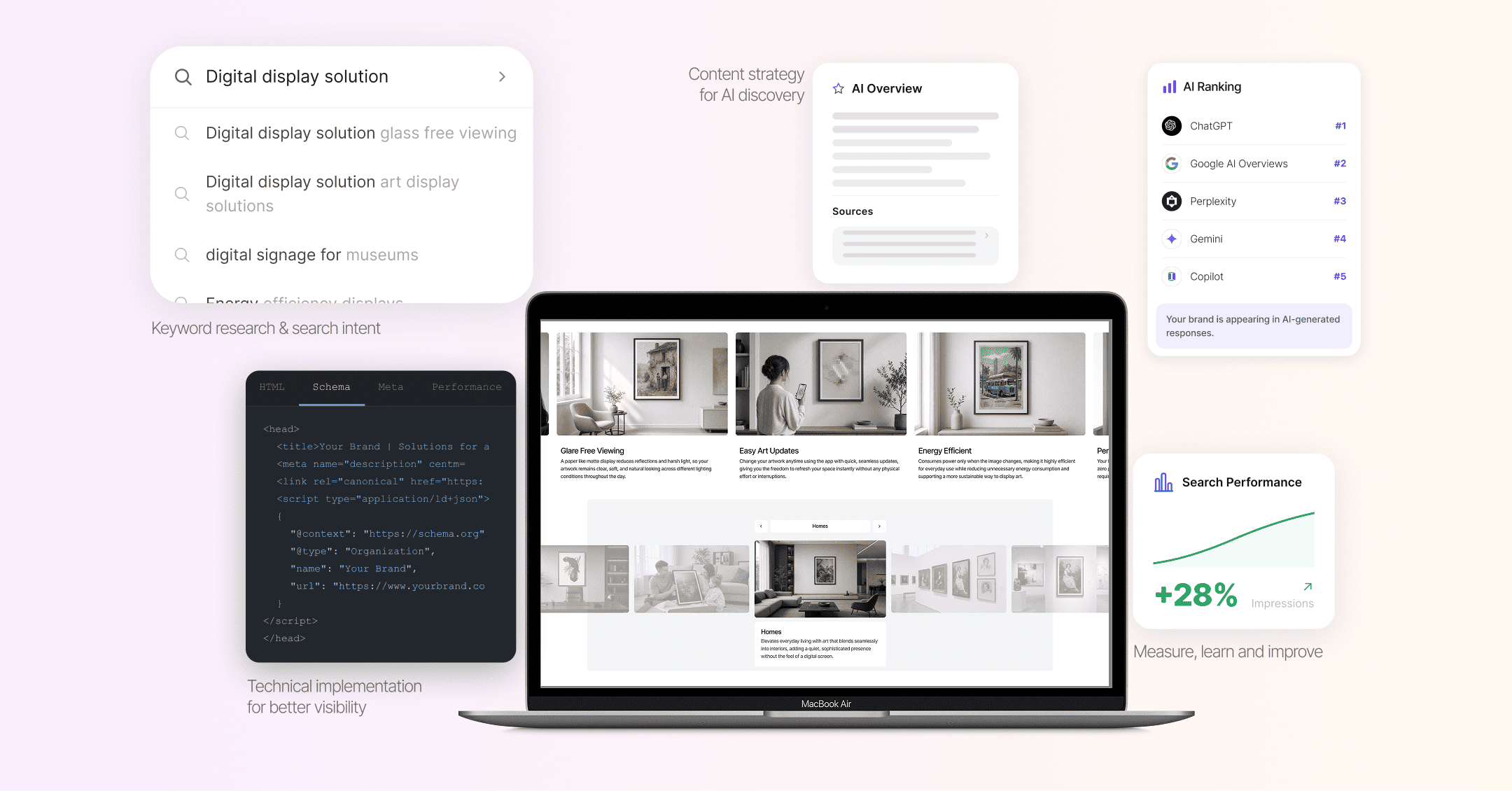
Illustration showing an AI-focused SEO and content strategy, with keyword research, AI search results, schema implementation, AI rankings, and search performance displayed around a laptop showing a digital display website.

Designing for How People Search Today

We treat SEO, AEO and GEO as overlapping layers of the same website strategy. Each influences how we structure content, design pages and develop the underlying experience, from search intent and crawlability to answer focused content, structured data and entity clarity.

01

Be Discoverable (SEO)

We help the search engines find, crawl and index the right content.

  • Keywords & search intent guide the information architecture.
  • Clear page hierarchy, URLs and internal linking connect related to the content.
  • Crawlable navigation, metadata and on page structure support search visibility.
  • E-E-A-T signals such as author bios, credentials, citations and trust markers reinforce content credibility for search engines and for readers.

02

Be Answerable (AEO)

We structure content so relevant questions can be clearly answered across answer engines and search experiences.

  • Question led content reflects how people search and the information they need.
  • Clear headings, direct answers and FAQs make information easier to find, extract and understand.
  • FAQPage and Q&A Schema markup make question and answer content machine readable for AI systems and search engines to interpret and surface.
  • Canonical tags and consistent NAP data reinforce content consistency and help search systems identify the correct version of information.
  • Page speed and Core Web Vitals support efficient crawling, loading and content processing before information is extracted.

03

Be Understandable (GEO)

We help in generative search understand the business, its expertise and its relevance.

  • Clear entities, definitions and relationships connect services, products, industries, use cases and expertise, giving AI systems stronger context.
  • Schema markup and structured data reinforce visible information and help machines interpret content meaning and relationships.
  • Fact dense, high quality content provides specific, useful information and stronger source material for generative systems.
  • Statistics, evidence and credible sources add factual depth, context and credibility.
  • Semantically rich content with unique value uses related concepts, terminology and original insights to cover topics authentically & meaningfully.
  • Clear information structure and machine readable content organise complex information logically, making it easier for AI systems to understand, connect and retrieve.

04

Be LLM Ready (LLM SEO)

We help to optimise content so language models can understand the business, its expertise and the context behind its information.

  • Authority, clarity and context help language models identify what the business does, who it serves and why its information is credible.
  • E-E-A-T, fact density and unique information strengthen the quality and usefulness of content for AI generated responses.
  • High quality, semantically rich content connects related topics, concepts and entities in a way that is easier for language models to interpret.
  • LLMs.txt and machine readable content help direct AI systems towards important website resources and make relevant information easier to discover and process.

Our Approach

  • Identify what the website needs to achieve: leads, enquiries, sign ups, visibility or sales
  • Understand the business & goals, offerings, audiences, competitors and market
  • Identify priority services, products, audiences and commercial opportunities
  • Research how people search on Google & other AI engines for the business, its services and related problems
  • Map primary, secondary, commercial, long tail and question based search opportunities
  • Identify the questions, search intent and information gaps across the customer journey, while uncovering opportunities for authoritative third party content and high quality backlinks that strengthen topical authority.

Outcome:
 A clear connection between business goals, user needs and the search opportunities the website needs to address.

  • Technical SEO Audit
    • Audit crawlability, indexability, site architecture, URL structure and internal linking to identify technical barriers that may prevent important pages from being discovered, crawled and indexed.
    • Review redirects, broken links, duplicate content and canonicalisation to ensure search engines can access the correct pages and understand the preferred version of each URL.
    • Review page speed, Core Web Vitals, mobile performance, responsiveness and other technical issues that can affect accessibility, usability and search performance.
    • Audit title tags, meta descriptions, URL slugs, H1, H2 and H3 structure and on page content to assess how clearly each page communicates its primary topic and search intent.
    • Review XML sitemap and robots.txt to ensure important website content can be discovered and crawled appropriately.
    • Audit Schema markup and JSON LD implementation, including relevant schema types such as Person, and assess whether structured information accurately represents the visible content on the page.
    • Review semantic HTML, crawlable navigation and machine readable content to identify opportunities to make important information easier for search systems to access and interpret.
  • On Page & Off Page SEO Audit
    • Audit focus key phrases, primary and secondary keywords, commercial keywords, long tail searches and question based searches to assess whether important pages are aligned with relevant search intent.
    • Identify content gaps, weak topical coverage and pages that need stronger search intent alignment to improve relevance and provide more complete information around priority topics.
    • Review headings, content structure, keyword placement, page depth and semantic relevance to understand whether each page provides useful information for its intended audience.
    • Assess images and supporting content for opportunities to improve relevance, context and accessibility without compromising the quality of the page experience.
    • Review the backlink profile, backlink quality, competitor backlink profiles and domain authority to understand the website’s current external authority and identify relevant opportunities.
    • Assess third party mentions, industry publications, expert contributions and other external authority signals that can strengthen topical relevance and E-E-A-T.
    • Identify opportunities to strengthen E-E-A-T through first hand experience, expertise, author bios, credentials, credible sources, citations, original insights and trust signals.
    • Review existing blogs, articles, case studies, FAQs and supporting content to understand how effectively they contribute to topical authority and connect with priority service and industry pages.
  • AEO & GEO Audit
    • Assess existing AEO and GEO visibility across relevant search and AI platforms, including Google AI Overviews, ChatGPT, Perplexity, Gemini and Copilot, to understand how the business is currently represented across AI based discovery experiences.
    • Map important customer questions, commercial queries and conversational searches to identify where the website needs clearer, more direct and easily extractable answers.
    • Review FAQ content, question led sections and concise answer formats to assess whether important information can be clearly identified and understood in answer based search experiences.
    • Audit structured information and relevant Schema markup to assess how clearly the website communicates entities, services, products, expertise and relationships to search engines and AI systems.
    • Assess entity consistency across the website, including consistent naming of the business, services, products, industries, people and other important entities.
    • Review fact density, statistics, evidence, credible sources, citations and original information to assess the depth and credibility of content available for generative search systems.
    • Assess semantic richness and topical relationships across services, industries, use cases, case studies, blogs and supporting content to identify opportunities for stronger GEO and AI discoverability.
    • Review how clearly the website communicates what the business does, who it serves, the problems it solves, its areas of expertise and the evidence supporting its claims.
    • Review LLMs.txt and other machine readable content as part of the wider AI discoverability assessment, identifying opportunities to make important website resources easier for AI systems to discover and process.
    • Assess current AI representation for accuracy and consistency, including whether important business information, services and expertise are being understood correctly across relevant AI experiences.
    • Identify opportunities for digital PR, expert contributions, credible third party mentions and other authority building activities that can strengthen the business’s wider presence across search and AI discovery.

Outcome:
 A clear picture of where the website is discoverable today, how effectively its technical foundation, content, authority and entities support search and AI discovery, and where SEO, AEO and GEO improvements can strengthen visibility, understanding and representation across search experiences.

  • Develop primary, secondary, commercial, long tail and question based keyword strategies
  • Map keywords and search intent to the right pages
  • Define topic clusters, pillar pages, blogs, case studies and supporting content
  • Structure content around real questions with clear, direct answers
  • Plan FAQs and question led sections around genuine user needs
  • Build semantic relationships between services, products, industries, use cases and expertise
  • Strengthen E-E-A-T through expert content, author bios, original insights and credible sources
  • Plan internal linking to connect related topics and strengthen topical relevance
  • Identify digital PR, expert contributions and relevant authority building opportunities

Outcome:
 A content and authority strategy designed to make the website easier to find, answer from and understand across traditional search and AI based discovery.

  • Build the sitemap, information architecture and page hierarchy around business priorities and search intent
  • Create clear H1, H2 and H3 structures and content hierarchy
  • Design pages around answer focused, scannable and extractable content
  • Use semantic HTML and crawlable navigation
  • Implement title tags and meta descriptions aligned with page intent
  • Implement canonical URLs, XML sitemap and robots.txt
  • Add relevant structured data and Schema.org markup based on the content and purpose of each page
  • Implement relevant schema such as Organisation, Website, BreadcrumbList, Service, Article and FAQ Schema
  • Structure FAQs around genuine user questions with clear, direct answers
  • Connect products, services, industries, use cases and expertise through internal linking and clear entity relationships
  • Keep important content available as accessible, machine readable text
  • Optimise images, performance, responsiveness and accessibility
  • Ensure important pages can be crawled and indexed by relevant search systems

Outcome:
 A website where SEO, AEO and GEO considerations are built into the information architecture, content and technical implementation rather than added after launch.

  • Track organic traffic, qualified traffic, rankings, impressions and CTR
  • Monitor which pages and topics are gaining visibility
  • Track engagement, conversions and onward journeys
  • Monitor AI and answer engine visibility, including citations and how accurately the business is represented
  • Monitor backlinks and authority signals
  • Review search queries to identify new content opportunities
  • Identify content gaps and pages that need improvement
  • Test important queries manually across relevant AI search platforms
  • Review technical SEO issues and indexing changes regularly
  • Update content, internal linking, metadata and structured data as the website evolves

Outcome:
 A website where SEO, AEO and GEO considerations are built into the information architecture, content and technical implementation rather than added after launch.

  • Identify what the website needs to achieve: leads, enquiries, sign ups, visibility or sales
  • Understand the business & goals, offerings, audiences, competitors and market
  • Identify priority services, products, audiences and commercial opportunities
  • Research how people search on Google & other AI engines for the business, its services and related problems
  • Map primary, secondary, commercial, long tail and question based search opportunities
  • Identify the questions, search intent and information gaps across the customer journey, while uncovering opportunities for authoritative third party content and high quality backlinks that strengthen topical authority.

Outcome:
 An ongoing cycle of search, content, technical and AI visibility improvements based on real performance data rather than a one time SEO setup.

Turning a Complex Service Portfolio into Clearer Discovery

Sellcraft offered a wide range of services, but the challenge was making that portfolio easier for potential clients to discover, navigate and understand. We started by connecting the business goals with audience needs, priority services and search behaviour, then mapped relevant primary, secondary, commercial, long tail and question based keywords to the right pages. This informed the information architecture, sitemap, service hierarchy and content structure, giving each capability a clearer place within the website and creating stronger relationships between related services. The result was a more focused digital experience, with 30% improved content discoverability and 25% better enterprise readability.
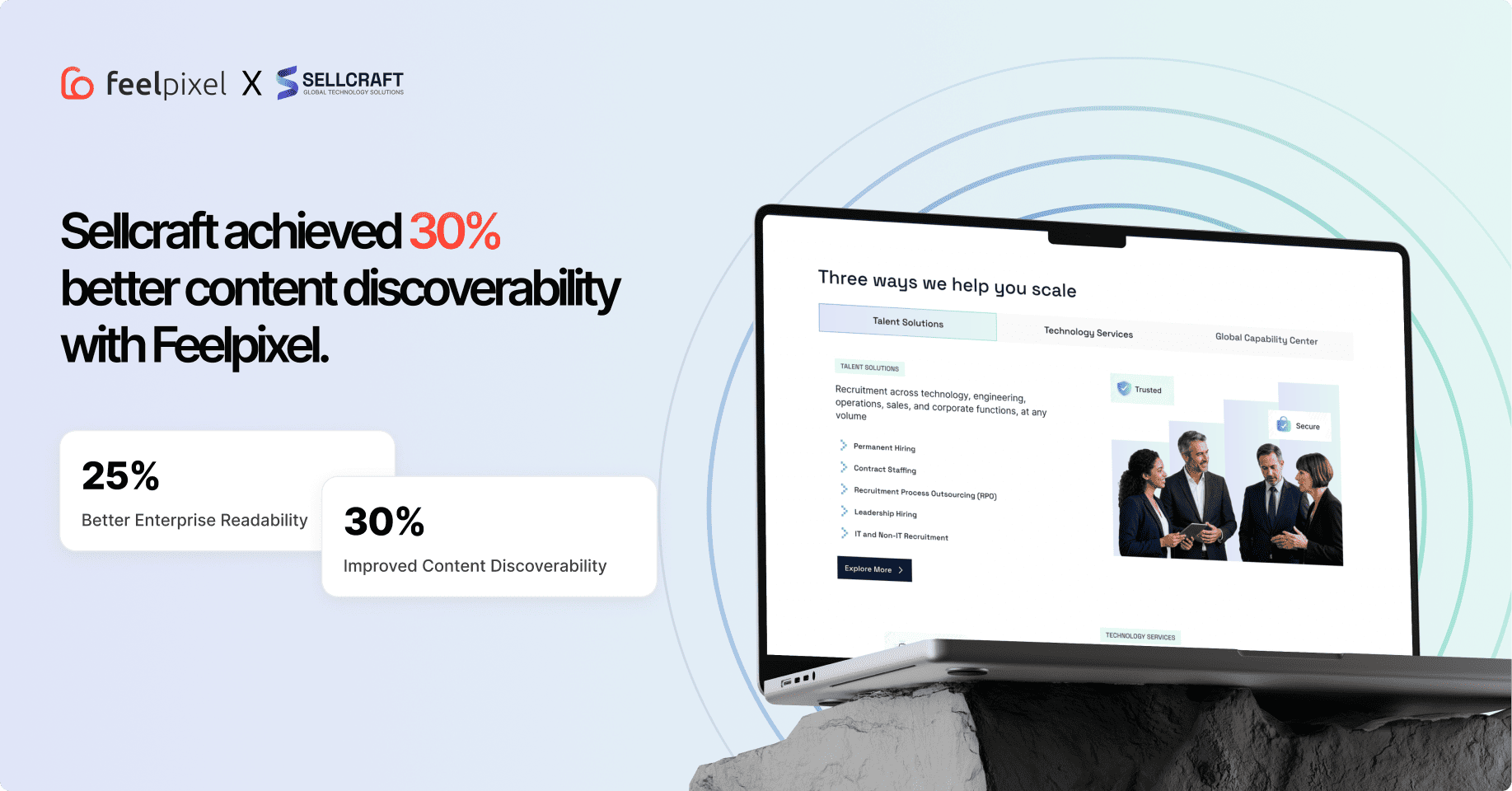
Sellcraft case study showing 30% improved content discoverability with Feelpixel, featuring website results, performance metrics, and a laptop displaying the redesigned website.

The new structure also gave us a foundation to build SEO, AEO and GEO into the website rather than treating them as post launch optimisation. We structured content around search intent and real user questions, strengthened the hierarchy through clear H1, H2 and H3 structures, and used FAQs and direct answers to make important information easier to find and understand. We also strengthened the technical layer through meta tags, canonical URLs, crawlable navigation, schema markup, FAQ Schema, XML sitemap, robots.txt and semantic HTML, while connecting Sellcraft’s services, expertise and supporting content through internal linking and clear entity relationships. The result was a website designed to communicate expertise clearly to people while making its content more accessible to search engines and AI based discovery systems.

Making content Discoverable for Relevant Searches

We mapped primary, secondary, commercial, long tail and question based keywords to Sellcraft’s priority services and aligned them with relevant search intent. This created dedicated content opportunities for important services and established a clearer topical structure across the website.

Structuring Content Around Search Intent

We aligned each page with the intent behind relevant searches, using H1, H2 and H3 hierarchy, focused page content, concise sections, semantic relevance and internal linking. This helped search engines identify the primary topic of each page and understand its relationship with related services and content.

Making Service Information Answerable

We identified questions potential clients may ask when researching Sellcraft’s services and structured the content around question led sections, direct answers and FAQs. FAQ Schema was implemented alongside the visible FAQ content, giving search systems structured information about these questions and answers and supporting AEO.

Strengthening E-E-A-T and Topical Authority

We organised Sellcraft’s expertise and service information into a more consistent content structure, supported by relevant service content and supporting resources. This helped establish clearer signals around Experience, Expertise, Authoritativeness and Trustworthiness (E-E-A-T) while building greater topical depth around Sellcraft’s areas of expertise.

Making the Website Technically Accessible to Search Systems

We organised Sellcraft’s expertise and service information into a more consistent content structure, supported by relevant service content and supporting resources. This helped establish clearer signals around Experience, Expertise, Authoritativeness and Trustworthiness (E-E-A-T) while building greater topical depth around Sellcraft’s areas of expertise.

Building a Scalable Search Content Structure

We created a scalable CMS structure that supports the continued development of topic clusters, blogs, case studies, FAQs and supporting service content. Internal linking connects these content areas, allowing new information to strengthen existing topics rather than creating disconnected pages.

From Product Browsing to Clearer Paths to Enquiry

Envision Displays had a broad portfolio of exhibition and portable display solutions, but visitors were finding it difficult to differentiate products, understand the right solution and move from browsing to enquiry. We redesigned the experience around product discovery and decision making, restructuring the information architecture around products, industries, solutions and use cases. By combining clearer product journeys with stronger content, trust signals and conversion points, the redesigned experience delivered 2.5x increase in enquiry submissions and 40% higher product page engagement.
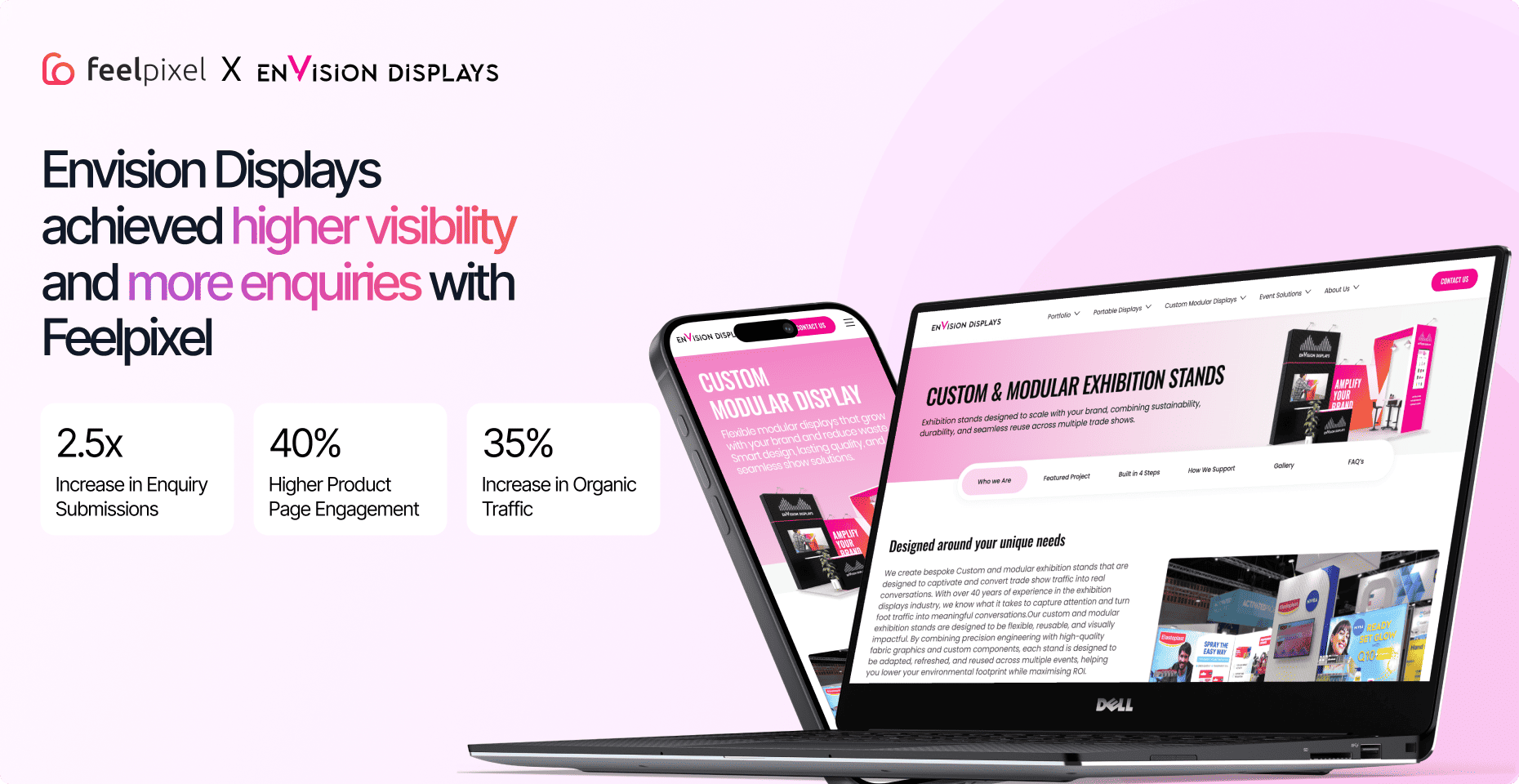
Envision Displays case study showing increased visibility and enquiries with Feelpixel, featuring the redesigned website on a laptop and mobile device with key performance metrics.

The new product structure also helped us build a stronger search strategy around Envision’s products. We mapped high intent, commercial, long tail and question based searches to relevant product, solution and industry pages, so each page had a clear search purpose. The goal was to help potential buyers find the right product through relevant searches and understand the information they needed before making an enquiry. Product specifications, applications, use cases and buying information were organised into focused sections with clear headings, internal links and direct answers to common questions. This made product information easier to discover through SEO and easier to use in answer based searches.
We used FAQ content and FAQ Schema to support AEO, while connecting products with their industries, solutions and use cases to give GEO and AI discovery more context. The goal was not simply to add more content, but to make the relationships between Envision’s products and expertise clearer to search engines and AI systems. Case studies and real world applications added supporting evidence, while the overall content structure kept important information clear, accessible and machine readable.

Making a Large content Easier to Explore

We reworked the information architecture, sitemap and page hierarchy around products, industries and solutions, giving each offering a clearer place within the website. This helped visitors move between related products and supporting information while strengthening the topical relationships that support search and AI discovery.

Strengthening Technical Search Foundations

We structured Envision’s product pages around high intent searches and the information buyers need before choosing a display solution. Product descriptions, specifications and applications were organised into clear, topic focused sections with relevant H1 and H2 headings, direct answers and internal links aligned to search intent. We also introduced FAQ content with FAQ Schema to structure common product questions and answers, making key information clearer for search engines and more useful for AEO, while the relationships between products, applications and supporting content strengthened GEO and AI discovery.

Answering the Questions Behind Product Decisions

We identified the questions users need answered before choosing a display solution and incorporated question based content, FAQs and direct answers into relevant pages. FAQ Schema was implemented alongside the visible FAQ content, creating a clearer structured representation of these answers.

Strengthening Topical Relevance Across the Website

We organised Envision’s content around the search intent and topics surrounding its display solutions, then developed supporting relationships between products, industries, solutions, use cases, blogs and case studies. Internal linking reinforced these topic relationships, while consistent terminology and structured content helped search engines and AI systems establish clearer context around Envision’s expertise and offerings.

Making the Website Easier to Crawl, Interpret and Maintain

We brought the content strategy into development through semantic HTML, crawlable navigation, structured content, metadata, relevant schema markup and a scalable CMS. This created a technical foundation that supports SEO while keeping important information accessible and machine readable for AI based discovery.

Frequently Asked Questions

1. Can Feelpixel build a website with SEO, AEO, GEO and LLM SEO considered from the beginning?


Yes. We consider SEO, AEO, GEO and LLM SEO throughout the website process, starting with business goals, search intent, information architecture and content planning. This allows search and AI discoverability to be considered alongside the website strategy, content, UX, UI and development rather than treated as a post launch activity.

Yes. We can audit a website across Technical SEO, On Page & Off Page SEO, and AEO & GEO to understand its current search and AI discoverability. The audit looks at technical foundations, content and search intent, authority signals, structured information, entity relationships and opportunities to strengthen the website’s discoverability.


Yes. These capabilities can be integrated into the website project based on the project’s size, goals and requirements. They can also be taken up as an additional service when a business wants to strengthen the search and AI discoverability of an existing website.

We bring together website strategy, information architecture, content structure, SEO, AEO, GEO, LLM SEO, UX, UI and development. This can include search intent and keyword mapping, page hierarchy, internal linking, metadata, schema markup, crawlable navigation, technical foundations, question led content and machine readable content.


Our approach focuses on making the business, its expertise and its information easier for AI systems to understand. We create clear relationships between services, products, industries, use cases and supporting content, while strengthening content with useful information, relevant context, credible sources and structured information. The aim is to create a website that is clear and accessible across evolving search and AI discovery experiences.


We begin by understanding the business, its goals, offerings, audiences, priority services and competitive landscape. Existing website access, analytics, search data, brand information, business expertise and relevant content can help us build a stronger understanding of the current situation. From there, we define the research, audit, content and technical requirements needed for the project.

Similar Projects

Got a project in mind?